The Experts Speak

Everyone’s an expert. -Seth Godin

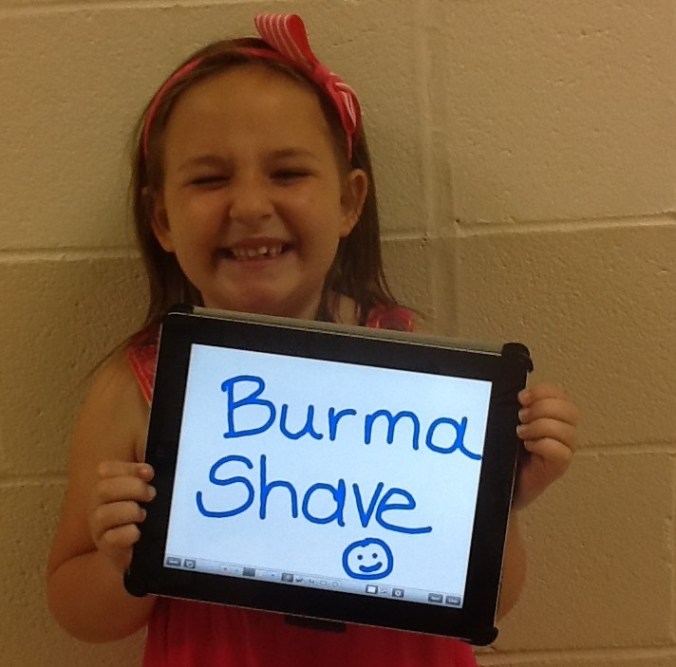
My very seasoned kindergartners are total iPad experts.  They know all the tricks.  They are able to put apps in folders, search for apps quickly using the search screen, save images from the internet, import images into a Pages document, save the document on PaperPort, take a screen shot, use the camera, save a document as  PDF, and if I would let them, they could probably order a pizza from Pizza Hut or a movie from Netflix.  As with all experts, they love to share what they know with others.  In their own words, they are sharing their advice for using iPads with next year’s kindergarten students and with you.

Always carry the iPad with two hands for safetyness.-Jason age 6

Never pick your nose and touch the iPad screen. That is gross. -Hagan age 6

Keep the volume on low or the teacher takes it away. -Parker Jane age 6

It is never ok to stomp on the iPad or throw it. -Kade age 6

There are lots of cool apps and you can learn very lots.-Amantay age 6

You will like the iPad so much you will want one for Christmas, but your parents will say no.  -Ella age 5

Don’t share your ear buds with anyone because your earwax is disgusting. -Jacob age 6

There were more, but these are the highlights.  They also had good things to say about how they can read a lot on the iPad, write stories, use it for learning new things, work on projects with other students, learn math and science, and blog with others.  Can you imagine being a 5 or 6 year old, and already know how to do the things these children can do? Next year in first grade, they will continue to grow in their skills and knowledge.

With all of this wonderful technology, comes responsibility.  Just as we aren’t gaining all of our adult knowledge from our smart phones, laptops and mobile devices, our students also need to learn from multiple sources.  Social skills, responsible behavior, courtesy, manners, and interpersonal relationships aren’t learned on the iPad.  Teachers and parents are role models for our children.  We still need to take our children outside and show them nature, curl up and read real books together, play board games together, ask children what they think and why they think that, model appropriate electronic device manners (put it away when you are at dinner or having a personal conversation), and model how and when it is appropriate to use technology.  While my students are very knowledgeable on the workings of the iPad and they are gaining 21st century skills in kindergarten, my role is more important than ever.

Being an expert often means someone who knows a lot about the past.  Moving into the future, means we all learn together.  Technology changes by the millisecond.  I have no doubt that my students will be on top of every advancement.  I just hope I can keep up!

I’d love for you to leave a comment, subscribe to my blog, and/or share this post with a friend.

Using Confer App in Reading Workshop

The biggest mistake regarding record-keeping is not writing things down or not remembering where you wrote it down.-David Mellem

Do you have an organized method for your record-keeping?  I have an old-school grade book and I have one on the iPad.  I have a stack for this and a pile for that.  One of the things that drive me crazy is having some things here and some things there. I have Language Arts and sight word assessments, math assessments, and running records for reading.  In my attempt to consolidate my “stuff” I discovered an app called Confer.

Confer is an app that lets you record and track your students both individually and in small groups.  I teach Reading and Writing Workshop and this app  works very well with that method.  I can take notes on individuals and small groups. I can view students by “tag”, “strength”, “teaching point”, or “next step”.  Creating small flexible groups allows me to see at a glance what those students are working on, what reading level they are on, or what I need to do next with them.  Confer also allows you to upload your data to a Gmail account as a spreadsheet or to upload to any iOS device or to Dropbox.

The downside is the cost.  It is $14.99.  There is a lite version, but it’s a little too lite.  The plus side is that it is easy to use and is very portable in the iPad.  While I use it exclusively for running records and guided reading groups, it can be used in any subject that you wish. When I meet with my grade level team, principal or a parent, I have the data right at hand.

With 30 kindergarten students, having the ability to look at student data in both small group, individual and whole class views quickly is not only convenient, it is necessary.

I’d love for you to leave a comment, subscribe to my blog, and/or share this post with a friend.

All You Need Is Love

Appreciation is a wonderful thing: It makes what is excellent in others belong to us as well. -Voltaire

This has been Teacher Appreciation Week at my school.  I have been thanked and celebrated, hugged and showered with flowers and gifts.  And…food.  I mean, nothing says lovin’ like something from the oven right?  My cup overflows.

While I have enjoyed receiving all of the love this week, I have appreciations of my own. One of the treats of teaching 5 year old children is their unending capacity for love and learning.  I love the buzz of activity in the classroom punctuated by hearty belly laughs that only children can do without the burden of self-consciousness.  I love how they aren’t afraid to try new things.  I love that even though we have these awesome iPads, and there is ongoing debate about whether they are worth the investment, and visitors come and go on a regular basis to see the iPads in action, these children are unimpressed with the hoopla surrounding them.  They just want to get to work. I love how they think it’s just another day in kindergarten, learning, singing, reading, writing, building with blocks, painting, tattling, adding, and subtracting with their teachers, their friends, and oh yes, iPads.

I also love the support from parents, my administrators, Apple, and the school district I have had the last 12 months implementing the iPads in the classroom.  All have been unwavering in assisting me with whatever I needed.  My school administrators and the district have trusted my judgment and given me plenty of latitude to be successful.  The parents have shown interest in the project, kept up with the apps we have and many have purchased them on their own iPads or iPhones at home.  They have asked questions and educated themselves so they can better help their children at home.

In the presence of all of this love, how can these children possibly fail?  Sadly, it is possible.  Future teachers of these children will help determine their love of learning.  As my little peeps get ready to leave me, I can appreciate the amount of work I have put into nurturing them and can only hope their future teachers will love them like I have.

I’d love for you to leave a comment, subscribe to my blog, and/or share this post with a friend.

Sweet 16: Countdown to Summer Vacation

Always desire to learn something useful.-Sophocles

16 days of school are remaining. While I am looking forward to summer vacation, part of me is wistful at seeing this class go. They are busy, talkative, and loud. (I won’t miss the loud part.) They are also inquisitive, bright, and eager to learn. They haven’t shut down for the impending summer vacation. They continue to go full steam ahead wanting to learn. This morning during her free time, Tahra was researching sharks on her iPad. After looking online, she thought of something she had seen in a book in the reading center on sharks. She went and got the book, found what she was looking for, and proceeded to blog about some shark facts.

Tahra knew how to access information she needed. More importantly, she had access to the information she needed. These are essential components to learning. It was gratifying to me to see her use both her iPad and the non-fiction text. Seamless learning. She was reading, researching, blogging…she was also highly engaged. At this point in our school year, I can smile knowing my work with these children is almost complete. They are equipped and ready to go to first grade (and beyond) with the skills necessary to be successful.

When asked how my students became so independent and engaged in their own learning, I answer with these words: intentional planning and constant modeling and monitoring. We must be intentional about our instruction both with and without iPads. Apps are carefully considered before purchasing. Student use of iPads and any other activity in which they will have some freedom is carefully modeled daily, if needed. I subscribe to “I do, we do, you do” philosophy. This is that important gradual release of responsibility.

As we count down the final days of this year, my students’ love for learning is evident. I watch my students stand on the edge of their own greatness. They aren’t looking down in fear…but looking forward with great anticipation. So am I, my little friends. So am I.

I’d love for you to leave a comment, subscribe to my blog, and/or share this post with a friend.

In the Dark: What Happens When You Lose Electricity?

Things work out best for those who make the best of how things work out. -John Wooden

And then there was darkness…a recent school-wide power outage left us without the use of my laptop, the Smart Board, overhead lights, air-conditioning…all of the things we take for granted every day and that are absolute necessities in my book.   An announcement was made that it was uncertain how long we would actually be without power.  Hmmm…what do we do, now that we can’t see to move around our classroom, and can’t use our Smart Board? Our technology-dependent classroom came to a screeching halt. 
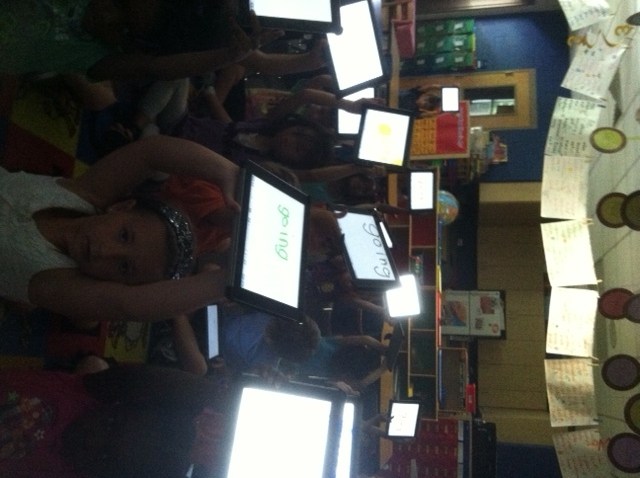
As I am using my iPhone flashlight app to move around without stepping on someone, it occurs to me that all is not lost.  We may not be able to see to read or write in the traditional ways,  but we do have iPads.  Our wonderful back-lit devices allows us to carry on even in darkness.  We can read, write, spell, add, subtract, complete patterns, count, draw, sing, do yoga, learn a foreign language,  ok…you get the idea.  We all sat on the rug and played a favorite spelling game.  Using our White Board app, I called out words and they wrote the words on their iPads.  They held them up to reveal their answers. The glow of the back-lit screens even contributed to the ambiance in the room.  Everyone lowered their voices and it was almost like we were in a really nice restaurant.  Almost.

We played our spelling game and before we knew it, the power was back on.  That 20 minute outage could’ve seemed like an eternity but we “powered” through with iPads.  The kids were disappointed when the lights came back on.

The Multi-touch White Board app by Shifting Mind is a very versatile one.  We use it for multiple purposes and in all subject areas. You have the ability to have up to 9 white boards in use at once.  It is also possible to type in text rather than write or draw.  It uploads nicely into the Pages app and eBook Magic.

We made the best of things on that day. The kids thought it was an adventure and even ask if we can turn off the lights in the classroom whenever we do whole group iPad activities on the carpet.  It seems to keep them quiet so I’m all for it!

I’d love for you to leave a comment, subscribe to my blog, and/or share this post with a friend.
Great Expectations: Closing The Achievement Gap With iPads

Definiteness of purpose is the starting point of all achievement. -W. Clement Stone

If you search the internet for technology and educational achievement, you will find a variety of opinions as to whether technology impacts achievement in elementary school.  Having taught school through a veritable technology spectrum that ranges from no classroom technology, to having an Apple IIe with no internet connection and a stack of 5 1/4 floppy disks, to 4  networked Dell Desktops and now iPads for each student, I can say the student motivation with technology has always been higher than without.

I’ve stated before that technology without purpose will not yield desired results.   Schilling and Schilling (1999) capture well the broad idea that expectations are vital to education. … the literature on motivation and school performance in younger school children suggests that expectations shape the learning experience very powerfully. For example, classic studies in the psychology literature have found that merely stating an expectation results in enhanced performance, that higher expectations result in higher performance, and that persons with high expectations perform at a higher level than those with low expectations, even though their measured abilities are equal.

In an earlier post, I shared reading results from the 2010-11 school year.  We used iPads from the end of January until the end of the year.  It was exciting to see such growth.  This year, with only 24 school days remaining, our data is equally exciting.

It is interesting to note that I had 2 students transfer in after Christmas as non-readers.  They are currently reading above grade level.  How is this possible? Systematic teaching in the Workshop Model and the ability to differentiate instruction to meet individual student needs on the iPad is the key.  Student-centric technology is the answer to the One-Size Fits All approach to learning.

The larger debate concerning the effect of technology on student achievement goes on outside our little classroom.  I’m not a statistician nor am I a researcher, but when 100% of my students are going to First Grade reading above grade level 2 years in a row, I would say iPads are an essential part of our learning environment.

I’d love for you to leave a comment, subscribe to my blog, and/or share this post with a friend.
Problem Solving and Math Apps

Before beginning a hunt, it is wise to ask someone what you are looking for before you begin looking for it.-Winnie the Pooh

Problem solving is a critical skill and a large part of the foundation for early learning.   Opportunities for problem solving exist in everyday life.  By exploring their environment, manipulating objects, thinking critically, and building on existing learning, students can strengthen problem-solving  skills.

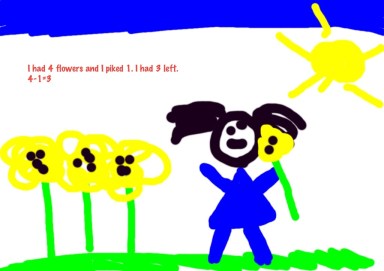
We have been using our iPads to create story problems in our Whiteboard App.  Students draw the story problem then type the number sentence to represent the picture.  We have even had a story problem exchange.  Students create the picture to represent either an addition or subtraction problem.  Then they pass their iPad to a friend who looks at the picture and figures out the appropriate number sentence.

Another activity my students have enjoyed is taking objects in our classroom such as unifix cubes or pattern blocks and creating a pattern.  They use their camera on their iPad to take a photograph and trade iPads with another student.  That student identifies the pattern and re-creates the pattern using Pop Beads app.

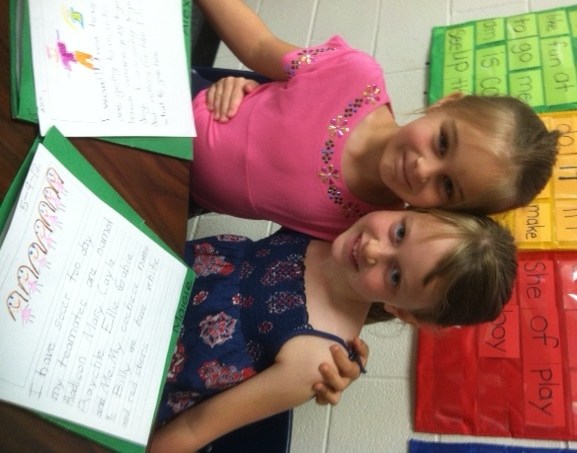
Using these manipulatives, students can make visual representations and I can model for students.  The iPads create another opportunity for practice and integration.  It can serve as a calculator, a notepad, an information resource, and flashcards.  It keeps score, tracks progress, and many apps monitor and adjust content.  iPads allow me to also integrate content.  The word problem in the above picture was created by a student after we studied seeds and plants.  She typed a science journal entry in Pages and then created her story problem.  The iPad allows for seamless integration of subjects that makes sense to students and increases their understanding of new concepts.

Other apps my students enjoy using in math are Math Bingo, Park Math, Monkey Math, and Flash to Pass.

By providing sustained opportunities for students to solve problems in a variety of contexts, they begin taking responsibility for their own learning.

I’d love for you to leave a comment, subscribe to my blog, and/or share this post with a friend.

Y-E-L-L Everybody Spell!

“It’s a poor mind that can only think of one way to spell a word.-Andrew Jackson

Um, did I mention these children are 5 years old?  Clearly our little ones are heavily influenced by our text-rich world.

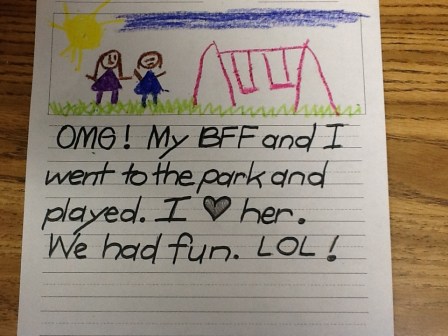
In kindergarten, we place emphasis on invented spelling. Invented spelling is the practice of young children using their best judgement when writing words.  This opens the children to using more of a variety of words than if they only write the words they know how to spell correctly.  Students write what they hear.  When students use invented spelling, they seem to develop word recognition and phonics skills sooner.  The more they write, the more confidence they have in their writing.  The process of getting it out of their head and onto the paper is the key rather than have them get bogged down in spelling words correctly.  My students are easily able to write several sentences on a given topic on their own.  We have environmental print in the room on the anchor charts, plus they use invented spelling.

Using the iPads, I am able to give the students opportunities to practice spelling high frequency words and word family words.  We use the app Spelling 1-2.  This allows students to work on their own list of words.  In the beginning of the year, I put their words in the app, but later they can put their own words in themselves.  They practice all week on their given list of words on the app and they are assessed weekly.  This ability to differentiate instruction allows my higher students to move on to more difficult words and my struggling students to practice what they need.  At one point this year, I had 4 different lists going on the iPads.  Now I’m down to 2.  With a class of 26 students, I am able to meet the needs of each of my students where they are. We  use a few other spelling apps for fun.  Two of the apps we like are Montessori Crosswords and Word Wizard.

As we allow students to express themselves in a safe, encouragement environment, we see the possibilities and their creativity flourish.

I’d love for you to leave a comment, subscribe to my blog, and/or share this post with a friend.
The Play’s the Thing!

Without this playing with fantasy, no creative work has ever yet come to birth. The debt we owe to the play of the imagination is incalculable. -Carl Jung

Play is an essential part of Early Childhood Education.  It stimulates cognitive, motor, and social skills.  Children are playful by nature and interact with their environment through play.  It reduces stress and promotes well-being.  Even now, in this time of high expectations and educational rigor, we still play.  Our class has learning centers for literacy, math, science, art, blocks, reading, Legos, housekeeping and iPads.  The children spend time in each of the centers every day. The structure of our day lends itself to creativity and self-directed learning; yet, it is still structured and the learning environment is carefully planned.  If you ask the children what they did all day, they will say, “I played.”
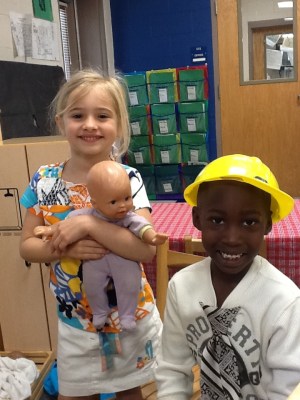
In the mornings, we have Reading Workshop, guided reading and literacy center rotations.  After lunch and recess, we have a whole group time where we have our shared reading, our read aloud and our word-work.  We also have discussion on whatever thematic unit we are on before going into Writing Workshop and more center rotations. Throughout the day, students are rotating in and out of small group instruction and center time.  The iPads serve as a tool in our classroom to facilitate  differentiation of instruction.  Even as Parker Jane and Dontay played in the housekeeping center (see picture above), they decided they needed to make a grocery list on their iPads.  They collaborated together to create a list in the Notes app.  I didn’t have to suggest that…they came up with the idea and moved to a table with an iPad to create a list of about 8 or so items, then they pretended to go shopping. One read the grocery list, while the other shopped.  As they are creating their own learning, they are problem solving, analyzing and synthesizing new information.
Play is all about exploring possibilities. In our world today,  exploring possibilities is a valuable skill.
Our classroom is a busy hub all day as students collaborate, learn, share, explore, inquire, and yes…play.

Making a grocery list for housekeeping center

I’d love for you to leave a comment, subscribe to my blog, and/or share this post with a friend.