As Easy as ABC…Magnetic ABC App

To succeed, you will soon learn, as I did, the importance of a solid foundation in the basics of education – literacy, both verbal and numerical, and communication skills -Alan Greenspan

One of the most challenging aspects of teaching is trying to meet all of your students’ needs.  In a room of 25 children, I have students who are reading and those who have just started learning letters of the alphabet, plus all other levels in between.  The iPads facilitate my ability to differentiate learning for all of my students.

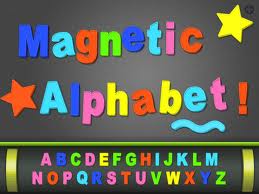
With my children that are still struggling with naming letters and sounds, we have been working with our Magnetic ABC appThis $1.99 app has upper and lower case letters and numbers.  It also has themes and objects available for use.  As an ABC practice activity, I call out an upper case letter and they choose it and put it on their board.  We scroll to the lower case letters and have them find the matching partner letter.  Sometimes I call out a letter sound and they have to find the letter that makes that sound.  Students who know their letter sounds practice with this app also. They can choose one of the objects and then match it’s beginning sound.   I can give them a CVC word and we stretch it out.  As they hear those sounds, they choose the corresponding letter. We can create word family words also.  The ability to use letters more than one time is a bonus.   More advanced students can make sentences dictated to them by either me or a partner.

The app also has numbers and objects.  Students can practice their numeracy skills, 1:1 correspondence, addition and subtraction, making sets less than, greater than or equal to, and patterning.  My students seem to enjoy the iPad version of this so much more than the real magnet letters on the cookie sheet that I put out in centers.  It’s also a lot easier to clean up!

Having a multipurpose app that meets a variety of student needs help me build a strong foundation in all students.  We can’t assume that students know these most basic of skills or short change their practice.  Apps that grow with students are efficient and effective.  Students are engaged and learning is underway. While these activities seem so…well, so basic, they are.   It just goes to show you that it doesn’t have to be fancy to be functional and fun!

I’d love for you to leave a comment, subscribe to my blog, and/or share this post with a friend.

Let’s Play!

“Play is the highest form of research.” ~ Albert Einstein

When you ask my students what they did at school on any given day, they will answer, “I played.”  For those unfamiliar with how young children learn, that answer can be unsettling.  Play gives children a chance to practice what they are learning. Play, by its very nature, is educational. It saddens me to see kindergarten classrooms doing away with centers. Fortunately, my principal sees the value of play in young learners.

My students have a variety of centers to “play” in each day.  These centers are carefully planned to enhance learning.  We have a reading center, a poetry center, a writing center, a math center, a science center, and an ABC center.  We have centers for blocks, legos, housekeeping, and art.  We use a rotation system in the morning while I teach guided reading groups and in the afternoon while small group guided writing occurs.  While students are at the ABC or at the math center, they may also choose iPads.  I have 2 iPad cards (or passes) in each of those centers.  2 students may work on iPads while at ABC and 2 at Math.  My apps are in folders and students at ABC may only work in the ABC folder while those at math may only work on apps in the math folder.  They must have the “pass” in order to use the iPads during that time.

I don’t start the “pass system” until a few weeks into school. I print them on card stock and laminate them. (See photo at left and click here to print your own.)

I need to make sure the children know where the folders are on the iPad and that they know how to properly use the iPads on their own.  They also know that if they are not in the appropriate folder, they will lose their iPads for the afternoon.  While I do monitor the students, my monitoring is nothing compared to the eagerness of my students to monitor (tattle on) each other.  By giving them these “controlled” opportunities to use iPads on their own, I am building up to having them use iPads in the reading center and other times as they deem they are needed in their learning.

Children need the freedom and the time to play.  When the fun goes out of play, most often so does the learning.  My students are engaged in a variety of structured play activities throughout the day. We include iPads as a part of those activities.  In play, children learn how to learn.  iPads give us the opportunity to extend and differentiate learning.

I’d love for you to leave a comment, subscribe to my blog, and/or share this post with a friend.

More on Anchor Charts

Tell me and I forget. Teach me and I remember. Involve me and I learn. -Benjamin Franklin

One of the first things we do in kindergarten (besides learning where the bathroom is) is to create an anchor chart together.  Anchor charts are charts that are created with the students to help them “anchor” their learning.  We make one for every letter of the alphabet, we make one with our classmates names, we make one for how to listen, we make one for colors, one for numbers, and any other skill I would like them to use on a regular basis.  We use them daily in our Reading and Writing Workshop activities.

My students love them and refer to them all throughout the day. They are engaged in the process of creating them so they take ownership in them.  After a while, they know more of what is on the charts than I do.  Space is a concern…and do I really need to leave a chart on Halloween words up all school year? Those questions are answered with the iPads.  I find that I leave the alphabet charts up all year; however, seasonal charts, or special charts made for a specific activity do not have to stay up and take up valuable wall space.  By photographing all of the anchor charts and syncing them out to the children’s iPads, they have the charts with them all year long regardless of whether they are on the wall or not.

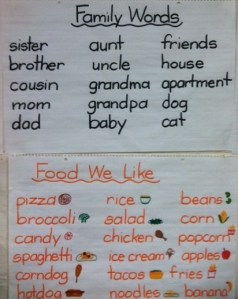
A recent writing activity included writing about our families.  After making the Family Words chart, they were able to refer to it all week as we discussed our families.  We also wrote about foods we liked.  By having the anchor chart, students were able to write about these foods.  In a week or so, I can add these to their iPads and they will have access to these words even if I take these charts down.

Another advantage of having these charts on the iPads is that students don’t have to walk across the room to see them if they are writing something and need a word.  The charts are also available if students are reading on their iPads and would like to read the charts.  It is like Read the Room, only it is done in their seats.

If you aren’t using anchor charts, I highly recommend them.  They are quick and easy but they pack a powerful punch.  Parents can even make them at home and post on the refrigerator or in the child’s room.

By involving the child in the learning, they create connections that are critical for mastery of skills.

I’d love for you to leave a comment, subscribe to my blog, and/or share this post with a friend.

Learning Phonics with iPad Apps

Practice is the best of all instructors. -Publilius Syrus

The beginning of every school year brings a variety of ability levels to kindergarten.  I have children who are already reading and some who struggle with just naming upper and lower case letters and sounds.  I’ve stated that the best part of having 1:1 iPads in the classroom is the ability to differentiate for student need.  There are a series of apps by Good Neighbor Press we use a lot in the beginning of the year.

The first app I use is the Upper and Lower Case Letter Matching Pocket Chart.  This has students matching upper and lower case letters.  It takes about 3-5 minutes to complete the cycle.  This is particularly good for my young learners who are still working with this skill.  It is easy to use and engaging as the students are earning stars for correct answers.  It also helps with the ever-confusing lower case b and d identification.  This app is .99

Beyond matching, another app in the series is Matching Beginning Sounds.  Again, this is a 3-5 minutes cycle that is highly engaging and keeps students moving through the app.
Other apps in the series include matching rhyming words, ending sounds, consonant blends and digraphs, word families, compound words, and long and short vowels.

Math apps are also available from this publisher.  There are apps for shape matching, position words, counting 1-20, number and number words matching, fractions and single digit addition and subtraction.  Each of these apps can be purchased individually, or for $4.99, you can purchase Pocket Charts Pro and receive all 20 games in one app!

One of the reasons I like this app is because pocket charts are common in many classrooms.  These apps are recognizable activities that don’t require a lot of front loading to use.  It also give you a quick sense of an individual child’s abilities.  While I may have 1 or 2 pocket charts available during centers for students to interact with, having a variety of pocket charts apps in their iPads means no one has to wait their turn.  Instant access!  Because there is a variety of skill levels within the app series, there is virtually something for everyone.  When you can deliver just-in-time-practice to each individual student, you are increasing engagement as well as allowing the child to move at his/her own pace.  Students who are ready to move on aren’t held back by those needing extra practice.  Those needing extra practice aren’t being rushed on by those who are ready to move on.

As I’m finishing the 10th day of school today and finishing up all of my initial assessments, I see I have a wide variety of student abilities.  By using apps such as those in the Pocket Chart series, I know my students are getting practice right where they need it!

I’d love for you to leave a comment, subscribe to my blog, and/or share this post with a friend.

The First Week of School

Excitement in education and student productivity, the ability to get a result that you want from students, go together and cannot be separated. -Major Owens

“Mrs. Meeuwse, this iPad has it all!  I can write and read and do math on it!” After 5 days of using iPads in the classroom, my kindergarten students are excited.  Did you notice that the child’s exclamation did not include the word play? That surprised me a bit.  They are so “play” oriented.   So far, no one as asked if they can “play” with their iPads.  They have asked if they can “work on them” or “get on them”.  Perhaps they are mirroring my own language in using them.  I am careful to use instructive language and modeling as we implement them slowly into our curriculum.  We have used them only in small group activities during guided reading  at this point.  My assistant and I both are showing them how to use key apps that we use frequently.

As we enter the second full week of school, I have completed my initial assessments and I have a better sense of what these small guided reading groups need to work on.  Since we use the Reading Workshop model, I have placed the children in small, flexible groups to work on specific skills.  One group is ready to read Level A books.  We have the LAZ level A readers on the iPads and this will give the children an opportunity to have just right books in their hands.  My students who need extra help in learning letters and sounds will have hands on time in centers with various manipulatives but they will also be working on a few specific apps to reinforce these skills.  One of these is the Starfall app.  Having a carefully mapped out plan creates comfort for you as the teacher, but also for the students as they know exactly what your expectations are.

The best part of having 1:1 iPads is all 25 of my students have access to apps that meet their individual needs. As we continue to work slowly and methodically through class routines and procedures both with and without the iPads, I’m reminded of Debbie Miller’s quote in Reading with Meaning: “We must be deliberate in September.”  Being explicit and deliberate about the smallest of details is important.  As our children become more confident in their abilities and activities in the classroom, their engagement soars, their inquiry shines and their excitement is unmeasurable.  We need to slow down to speed up!

I’d love for you to leave a comment, subscribe to my blog, and/or share this post with a friend.
Introducing iPads to Kindergartners

From small beginnings come great things. -Proverb

Today was the day. After a nice restful weekend and a bottle of Extra Strength Excedrin tucked away in my school bag, I was ready to seize the day.  I was ready to take the big step.  Today was the day to introduce iPads.  It was our 4th day of school and my students were itching to get their hands on them.  I had been asked repeatedly over the first 3 days, “When can we use the iPads?”   I kept telling them, “soon”.  As a child I hated that response from an adult.  Soon was never soon enough.  It wasn’t that I didn’t want them to use the iPads, I just wanted to skip over the “here’s how to use them” part.  You know, the boring stuff.  The oh-so-important-do-not-pass-go-do-not-collect-$200-do-not-rip-off-this-tag-under-penalty-of-law important kind of boring stuff.  5 year olds have a casual relationship with the “fine print”.

As soon as I said iPads today, there was instant silence, then instant cheers.  Uncontainable excitement.  I rolled them out in small groups.  5 at a time, keeping the basics short and sweet.  I took each child’s picture on his/her individual iPad and made it the home screen and the wallpaper.  This makes it instantly recognizable when opened by all.  We went over turning it on, navigating screens, choosing an app, closing the app, and putting the iPad to sleep.  We went over how to hold it, how to carry it and where to put it when finished.  Wide eyed and smiling, their joy was apparent. Their engagement was instant. Then, oh so quickly, their time with the iPads was finished and we had to put them away.  One by one, they returned them to the charging cart so I could lock them away for the day.  One child leaned over and said softly to his iPad, “Goodnight iPad. We can play again tomorrow.”

As for the rules and procedures, we get to do it all over again tomorrow and the next day and the next.  Modeling and reinforcing the “fine print” ensures that our  small beginnings will soon produce great things!

I’d love for you to leave a comment, subscribe to my blog, and/or share this post with a friend.

Going for Gold

Be firm on principle but flexible on method. -Zig Ziglar

Watching the Olympics the past 2 weeks, I’ve marveled at the flexibility of the athletes, particularly the gymnasts.  They can put their bodies into positions that seem almost super-human to me.  I can’t even bend over and touch my toes.  Their abilities come from intentional practice, training and coaching.

Flexibility isn’t restricted to range of movement with our joints and muscles.  It is also about being willing or disposed to yield.  I’ve been teaching for, well, forever it seems.  It is super easy for me to reach into my file cabinet, pull out a unit of study and go on autopilot…teaching the same lessons, using the same examples, smoothing out the same, wrinkled and faded artifacts and expecting the same answers from my students.  It is literally, a no-brainer.

The longer we teach, the easier it is to develop tunnel vision.  A few years ago, I found myself going through the motions of teaching.  I wasn’t happy but couldn’t figure out why.  My rigidity was more like rigor mortis. When I started using the iPads, I found a new spark of excitement that energized my teaching.  I found the joy of student-led learning and being open to the moment.  When I became present, I discovered how my students became more engaged.  I realized that being on autopilot is a death knell to the classroom.

To be sure, iPads required a new flexibility for me.  I still had an overarching goal but I learned to be not just accepting of student-led learning, I became expectant of it.  The beauty of this shift in my teaching was that my students exceeded even my usually high expectations.  My mantra to teachers in other grades who seem reluctant to incorporate iPads is “If my 5 year old kindergartners can do it, surely your students can also.” Just like those Olympic athletes, our own teaching flexibility requires intentional practice, training and coaching.  It starts from the top in administration.  When administrators create a culture of flexibility, team-work, and open-mindedness, then teachers feel empowered to try new things, reach beyond what they think is possible, and “Go for Gold!”

Are there parts of your life/career that are on autopilot?  Try to find one thing that you can change and allow yourself to feel energized by it.  Your enthusiasm will be contagious!

I’d love for you to leave a comment, subscribe to my blog, and/or share this post with a friend.

Collaboration

As you navigate through the rest of your life, be open to collaboration. Other people and other people’s ideas are often better than your own. Find a group of people who challenge and inspire you, spend a lot of time with them, and it will change your life. -Amy Poehler

What do educators talk about?  Even when not in the classroom, getting a bunch of educators together means “school talk”.  At a recent social gathering, I found myself huddling up with my teacher friends and commiserating with them about the ending of summer and the beginning of another year.  It is ironic that in a profession so centered around human interaction, teachers often find themselves feeling very isolated.

Spending time with other educators, engaging in meaningful conversations and talking through ideas is critical for effective teaching.  With the addition of new and ever-changing technologies, that collaboration is more necessary than ever.  Some teachers push through new ground effortlessly and others may need a little more guidance.  When experiencing difficulty, some teachers may feel reluctant to ask for help.  Others may feel they are the only one having difficulty.  We are quick to encourage collaboration with our own students and less likely to engage in it ourselves.

At the school district level and at my school level, we believe firmly in the “Train the Trainer” model.  Empowering teachers at their own schools builds a cadre of knowledge.  With the implementation of the iPads, the 3 of us who participated in the original pilot worked with our staff to train them.  We created a vanguard of sorts by also working closely with our school technology committee.  This committee consists of one teacher from each grade level.  This way, each grade level team had a point-person to check with first if questions or problems arose.  Our technology committee meets monthly to go over what is working and what needs attention.  Grade level teams meet weekly. During these meetings, we have a “Ten Minute Tech Time”.  We share what we are doing in our classrooms with the iPads and discuss any questions or issues that we may be having.  This built in time ensures that teachers are voicing their ideas, questions, and/or problems.  Our school district’s Ed Tech team are frequent visitors in our school and in our meetings.  They are quick to offer support, suggestions and solutions.

Teaching today is hard enough.  Collaborating with your colleagues and other educators can broaden ideas, provide support within the system and sustain teachers as we all navigate through the Technology Turnpike.

I’d love for you to leave a comment, subscribe to my blog, and/or share this post with a friend.

Back to the Basics: Planning for a New Year

The beginning is the most important part of the work.- Plato

I go back to school in exactly 17 days.  *Sigh*.  The new school year always brings a convoluted mix of emotions.  Few advents bring such excitement and dread. However, one thing I have learned over the years is the absolute necessity to start the year right with your students by front loading procedures.  Harry Wong is an educator, speaker and author.  He states that “The three most important student behaviors that must be taught on the first day of school are discipline, procedures, and routines.” By being vigilant the first few weeks of school in establishing rules and routines, you set yourself up for a successful rest of the year.

Implementing iPads at the start of the year also requires front loading of procedures and rules.  Whether you have a class set like mine or a few for students to share, proper use is an integral part of classroom management.  Our school year starts on a Wednesday.  I spend those first 3 days teaching classroom procedures and do not incorporate iPads.  Older grades whose students used iPads the previous year might not need to wait 3 days.  With 5 year old students (and some are actually 4), I need all 3 of those days to get classroom procedures rolling.  The next week, I begin pulling small groups of students for reading groups.  I will introduce the iPads in those small groups.  We learn how to turn them on and off, how to navigate screens, how to hold them and how NOT to hold them.  We work our way through a few phonics apps and then put them away.  We will do that each day for that first full week of school, while continuing to go over all other classroom rules and routines.  The second full week, I will usually do a whole group math activity or phonics activity with the iPads.  We continue to reinforce proper use and handling and I model desired activities by connecting my iPad to the Smart Board.  Students can watch and follow along.  This has been successful for me in using the iPads the last 2 school years.

Those without class sets of iPads need to define how you want them used before giving them to students.  The old adage “Failing to plan is planning to fail”, comes to mind.  While there is nothing wrong with letting students freely explore the iPads, there needs to be a broader vision of their use.  This vision should be systematically communicated to students as they integrate them into the classroom.

I also find it helpful to think of what trouble students can get themselves into and be proactive.  The iPad has several features which allow you to control student access.  The first thing I do is turn off the “in app purchase” feature.  You can also turn off the camera, access to Safari and deleting apps features.  I don’t turn those off in general, however, if you have someone using the iPad in ways you don’t want, these are alternatives.

Starting the school year with iPads is exciting.  Having a firm vision on their use and purpose will help guide you through the first few weeks.  When in doubt, go back to the basics!

I’d love for you to leave a comment, subscribe to my blog, and/or share this post with a friend.

Summer Fun and Draw Something

A vacation is having nothing to do and all day to do it in.  –Robert Orben

I live 10 minutes from this beach.  It serves as both an inspiration and a distraction depending on your frame of mind.  After a long school year, it is a soothing medication to frayed nerves.  The wind and waves are hypnotic.  On this day, soaking up the warm sun, I find I must confess something…

I am addicted to the Draw Something app on my iPad.

Draw Something is a free social drawing game you play with others.  You can find friends through email or Facebook.  Once you create a game with someone, you are given 3 words of varying difficulty to choose from.  You choose the word and draw.  When finished, it goes to the other person who watches your drawing being created on their screen.  They are given a tray of letters at the bottom they must choose from and re-arrange to guess the word.  Once they guess, it is their turn to draw and you must guess.  Coins are earned for the varying difficulty of the pictures drawn and they may be exchanged for additional colors. It is similar to the game Pictionary.  I find that using a stylus is much easier for drawing than using my finger.  It is fun and I think I mentioned…addictive. 

While this app isn’t appropriate for my students, the concept is appropriate. Initially, I could introduce the game on my iPad with the Whiteboard app.  I could draw something they would be familiar with and have a few letters at the bottom for them to unscramble to guess the word.  Showing this on my Smart Board would allow all to see and participate.  Once they have the concept of the game, they could then partner play on their own.  This would build spelling skills, vocabulary and fine motor skills.

Of course, I will spend this summer in *ahem* Research and Development to perfect any “kinks” to make it easier for my students…after all, it is about them right? Um, gotta run…it’s my turn and I need to figure out how to draw Lady Gaga.

I’d love for you to leave a comment, subscribe to my blog, and/or share this post with a friend.