Using Anchor Charts with iPads

I like to read and write about trucks and cars. I would do it all day long.-Kade age 6

How many students would like to read and write all day long?  I love how when I say it’s time for Reading or Writing Workshop, my kids give a fist pump and say, “YES!”  I’m pretty sure I was never that excited in school.

When children are engaged, and feel confident in their abilities as readers and writers, they are excited about learning.  We use the Reading and Writing Workshop model to teach literacy.  My room is filled with various anchor charts that I create along with the students.  At the beginning of the year, we make an anchor chart for each letter of the alphabet.  The children give me words that begin with the given letter and I model writing it on the chart  and draw a small picture beside it.  We then hang the chart on the wall.  When all of the alphabet charts are made, we go to word families and commonly used words, family words, color words, number words, etc.  We make charts about how to be good listeners when we are launching the workshop model in the fall.  We make charts on why writers write.  We make charts for non-fiction writing ideas, and for what we do when we are in the reading center.  These charts are available for the children to refer to all year long.  Because they helped in the creation of them, they are quick to use them and they serve as a visual reference.

The only problem is that I am out of wall space and even after stringing clothesline across my room, I still do not have enough space.  I wanted my students to still have access to certain charts but I needed to make room for more! I started taking pictures of some of the charts and I synced them out to each student iPad.  The charts are now in each student’s camera roll.  The ones we use all the time are on the wall and they are able to still see other charts when they need to. We made this Ideas chart because earlier in the year, some students were having trouble thinking of things to write about. This is one of the charts on their iPads.
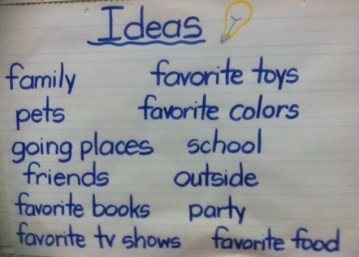
Ideas chart

The other plus for having them on the iPad camera roll is students have the ability to look at them right where they are.  If a child is sitting across the room from one particular anchor chart, they don’t have to get up to go across the room to look at it.  Since my students can only remember one letter at a time when copying something, they might make 6 trips across the room to see a particular word.

Anchor charts are wonderful reference tools that help “anchor” new and ongoing learning to previously introduced concepts. My students know exactly what is on each and every chart and they use them all throughout each day.  Long after I’ve forgotten what is on the chart, they still refer to it with each other. At the end of the year, I take them down and give one to each child to keep.  They love it!

I’d love for you to leave a comment, subscribe to my blog, and/or share this post with a friend.
All You Need Is Love

Appreciation is a wonderful thing: It makes what is excellent in others belong to us as well. -Voltaire

This has been Teacher Appreciation Week at my school.  I have been thanked and celebrated, hugged and showered with flowers and gifts.  And…food.  I mean, nothing says lovin’ like something from the oven right?  My cup overflows.

While I have enjoyed receiving all of the love this week, I have appreciations of my own. One of the treats of teaching 5 year old children is their unending capacity for love and learning.  I love the buzz of activity in the classroom punctuated by hearty belly laughs that only children can do without the burden of self-consciousness.  I love how they aren’t afraid to try new things.  I love that even though we have these awesome iPads, and there is ongoing debate about whether they are worth the investment, and visitors come and go on a regular basis to see the iPads in action, these children are unimpressed with the hoopla surrounding them.  They just want to get to work. I love how they think it’s just another day in kindergarten, learning, singing, reading, writing, building with blocks, painting, tattling, adding, and subtracting with their teachers, their friends, and oh yes, iPads.

I also love the support from parents, my administrators, Apple, and the school district I have had the last 12 months implementing the iPads in the classroom.  All have been unwavering in assisting me with whatever I needed.  My school administrators and the district have trusted my judgment and given me plenty of latitude to be successful.  The parents have shown interest in the project, kept up with the apps we have and many have purchased them on their own iPads or iPhones at home.  They have asked questions and educated themselves so they can better help their children at home.

In the presence of all of this love, how can these children possibly fail?  Sadly, it is possible.  Future teachers of these children will help determine their love of learning.  As my little peeps get ready to leave me, I can appreciate the amount of work I have put into nurturing them and can only hope their future teachers will love them like I have.

I’d love for you to leave a comment, subscribe to my blog, and/or share this post with a friend.
Sweet 16: Countdown to Summer Vacation

Always desire to learn something useful.-Sophocles

16 days of school are remaining. While I am looking forward to summer vacation, part of me is wistful at seeing this class go. They are busy, talkative, and loud. (I won’t miss the loud part.) They are also inquisitive, bright, and eager to learn. They haven’t shut down for the impending summer vacation. They continue to go full steam ahead wanting to learn. This morning during her free time, Tahra was researching sharks on her iPad. After looking online, she thought of something she had seen in a book in the reading center on sharks. She went and got the book, found what she was looking for, and proceeded to blog about some shark facts.

Tahra knew how to access information she needed. More importantly, she had access to the information she needed. These are essential components to learning. It was gratifying to me to see her use both her iPad and the non-fiction text. Seamless learning. She was reading, researching, blogging…she was also highly engaged. At this point in our school year, I can smile knowing my work with these children is almost complete. They are equipped and ready to go to first grade (and beyond) with the skills necessary to be successful.

When asked how my students became so independent and engaged in their own learning, I answer with these words: intentional planning and constant modeling and monitoring. We must be intentional about our instruction both with and without iPads. Apps are carefully considered before purchasing. Student use of iPads and any other activity in which they will have some freedom is carefully modeled daily, if needed. I subscribe to “I do, we do, you do” philosophy. This is that important gradual release of responsibility.

As we count down the final days of this year, my students’ love for learning is evident. I watch my students stand on the edge of their own greatness. They aren’t looking down in fear…but looking forward with great anticipation. So am I, my little friends. So am I.

I’d love for you to leave a comment, subscribe to my blog, and/or share this post with a friend.

Knowledge is Power: Students Taking Charge of Their Own Learning

Research is creating new knowledge.-Neil Armstrong

We have been studying the rainforest.  Kids love animals and the plethora of exotic animals in the rainforest creates instant interest and curiosity.  One day the wonderment and inquiry had reached fever pitch.  “Does the poison arrow frog have any predators?” ” How big is a giant anteater anyway?” “Are howler monkeys nocturnal or diurnal?” And my personal favorite question that was asked, “How does chocolate come from the rainforest?” I started writing down all of our questions so that we could figure out how we would solve them.  Before I finished, someone said, “I think we should look on Safari on our iPads.” Someone else immediately asked if they could “research” rainforest to find some answers.  Do you see the rich vocabulary here?  These questions and statements are not being paraphrased.  This is what happens when children feel empowered to take charge of their own learning. I barely had nodded yes to the research question when my room looked like the start line at the Boston Marathon.  Someone found a website on Safari that had several rainforest animals.  Peer sharing began immediately.  The students started finding images and information about animals that interested them.  They helped each other and they were engaged, focused and excited.  Without me giving any directions…on their own they started saving images and importing them into Pages.  They debated font size, picture size and word choice.  I facilitated, checked-in with groups, answered a few questions and mostly just let them have at it.  Their conversation was rich with the language of inquiry. They worked on this for over an hour before we had to stop. After lunch they came back to it and worked until they finished.  Here is one student’s work that is finished. Keep in mind these children are 5 years old and have no keyboarding skills other than “hunt and peck”.

This lesson was completely student-driven.  It all started with me reading a non-fiction book on the rainforest.  My plan was to go in a different direction but once the questions started, I knew my plan was out the window and we were headed down a different path.  But…isn’t that how it’s supposed to be?  Inquiry-based learning teaches problem solving and critical thinking skills. It develops student ownership of their learning and builds student interest in the subject matter.  Inquiry allows students to create their own knowledge. The iPads give the accessibility needed for each student to do the research.  With only 4 computers in our class just 2 years ago, this would have never been possible.

I’ve been asked what happens when the children become bored with the iPads.  They say, “Oh, it’s a source of fascination now, but what happens when it no longer is?”  My answer to that is two fold.  First, if it is being used as a toy and not a learning tool, then it will gather dust on a shelf somewhere.  However, if it is integrated into the curriculum properly, it will be as valuable to students as our own laptops, smartphones, and computers are to us as adults.   When was the last time you used a phone book to look up a phone number or address?

My friends, knowledge is power.  Our students are overflowing with wonder and an urgency to learn.  We need to equip them with all the tools necessary to be successful.

I’d love for you to leave a comment, subscribe to my blog, and/or share this post with a friend.

Gettin’ Buggy With It…Using iPads for Literacy and Science

“Do not limit children to your own learning, for they were born in another time.”  Chinese Proverb

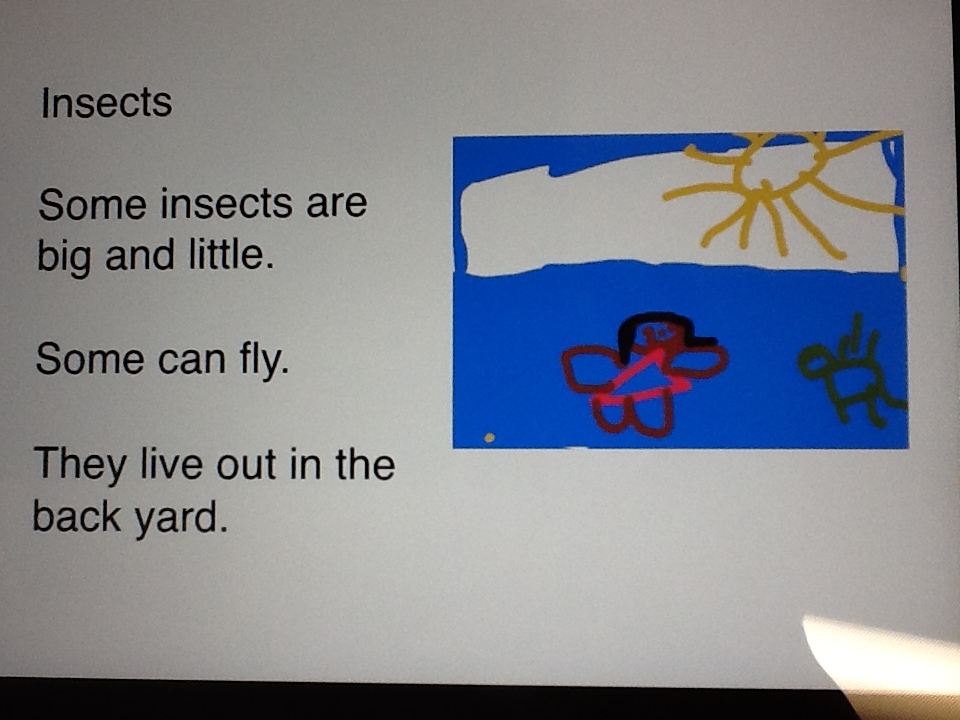
One of the most exciting aspects of using the iPad is integrating it with the content I am covering in class.  We’ve been discussing insects, and what 5 year old isn’t fascinated by bugs?  Today, my students used the Pages app as a science journal to write about insects and then created illustrations in their Whiteboard app.  Afterward, they imported their picture into the Pages document and re-sized it to fit on the page.  Throughout the process, they were buzzing (no pun intended) with each other about their insect facts, helping one another with importing their illustrations, and proudly sharing their masterpieces.  In addition, as children shared their work, they were reading and developing fluency.

Many years ago, when I was in kindergarten, I was given a fat, black, eraser-less pencil and primary-lined paper to write on. I am left handed and as I wrote, my hand smeared my words.  Unable to erase, I would get frustrated and not want to write.  Even in the early 80’s when I was in college, I had no computers available or even typewriters to type my papers.  As our students move into the digital future, they will learn by doing.  I am preparing them for jobs that don’t even exist yet!  It is crucial that content be engaging and relevant and that the rigor in our classrooms promote those higher order thinking skills.  If you break down this iPad exercise into steps, this is what they had to do:

1.  Open the Pages app and change the font size.

2. Type the title and their content. (which is no small feat since they don’t have keyboarding skills, plus they are sounding out their words at the same time)

3.  Open Whiteboard app, create illustration and save it

4.  Go back to Pages and import illustration and re-size.

5.  Read and share

On the revised Blooms Taxonomy, these students were creating, evaluating, analyzing and applying.

This isn’t old school kindergarten.  We are cutting-edge, 21st century learners!

Listen to Gracie read her insect story from her iPad…


I’d love for you to leave a comment, subscribe to my blog, and/or share this post with a friend.

It’s Just How We (Blog)Roll…

“Most of the basic material a writer works with is acquired before the age of fifteen.”-Willa Cather

This week, I stepped into the world of blogging on the iPads with my kindergartners.  Through KidBlog students can blog in a safe and secure way. The website states “Kidblog’s simple, yet powerful tools allow students to publish posts and participate in discussions within a secure classroom blogging community. Teachers maintain complete control over student blogs. ”

What could kindergarten students possibly have to say in a blog?  Seriously?  Have you been in a kindergarten classroom?  They ALWAYS have something to share.  This forum allows them to share as much and as often as they like.  Blogging supports writing and reading skills as well as digital literacy.

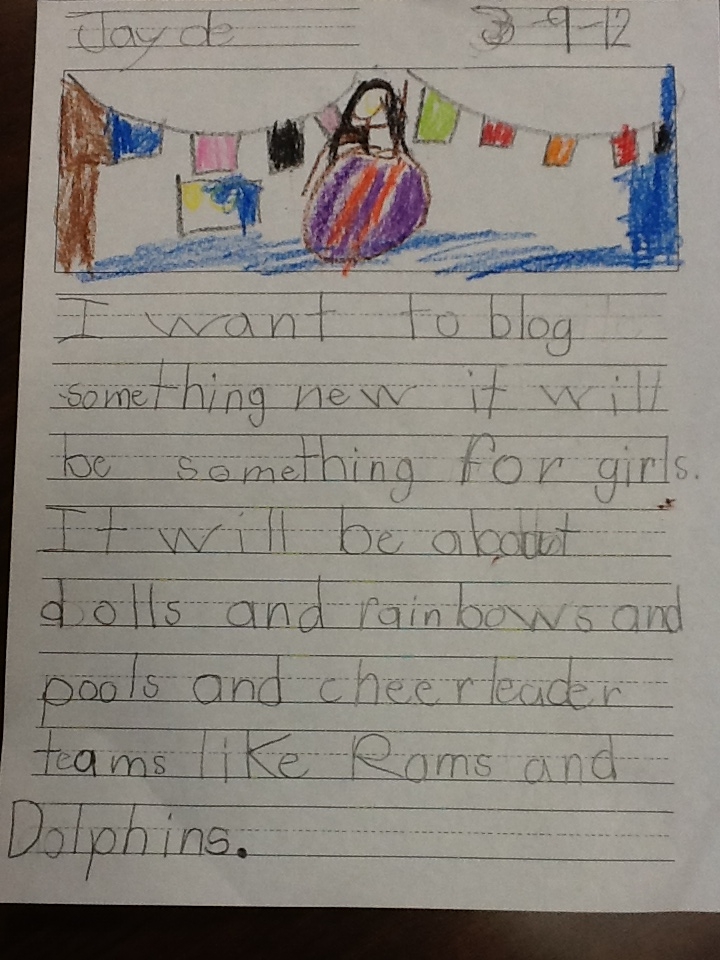
I showed my students this blog and then talked with them about what they might want to share on their own.  We brainstormed different ideas and then off they went making lists on their iPads of possible blogging topics.  I posted to the class and then had them read and respond to my post first.  Then I had them write their own posts. Next, I had them choose some of their classmates posts to read and respond.  This all happened in one day!  Since then, each day, they are asking me if they can please write in their blogs.  My next step is to connect with a first grade class in our building and become Blogging Buddies.

Obviously, I am monitoring all posts and comments.  I am also posting on the blog site and responding to their blogs.  This modeling is important.  The students get excited when they see I have responded to their blog.

One student’s thoughts about blogging

Blogging is allowing my students to bring their own voice alive in the classroom and construct their own learning.  It gives them an important sense of being a writer.  After all, we are what we think we are.