Directions At Their Fingertips

Read the directions and directly you will be directed in the right direction. -Lewis Carroll

I know there are a million jokes about a certain gender  *ahem* not wanting to stop and ask directions.  I am one of those people who don’t like to read the directions.  I tend to jump right in and when all else fails, I read the directions….and if Dr. Phil were asking, I would have to answer that hasn’t always worked out so well for me.

Our students need directions all day and they look to us for them.  Sometimes they need those directions repeated once and sometimes multiple times.  It can be difficult to fulfill that need when there are others who also need your time and attention.  Part of personalized learning, however, is giving them what they need, when they need it.

I’ve started recording directions with my iPad for each of my literacy centers and putting them in a book in the Book Creator app. This week we have been learning about the Rainforest.  I created a video for my vocabulary center, journal center, reading center and word work center.  These are then put in Book Creator.  I named it Rainforest Centers and saved it to the Box App.  My kids go into Box and save it to their iBooks.  The directions are there for them whenever they need them.  They can put their ear buds in and listen as many times as they need.  The best part for me is twofold: 1. They don’t have to interrupt me to ask for directions and 2. Once the book is created, I can reuse it next year if I want.

Ultimately, my plan is to create 2 or 3 sets of directions for each center to benefit students working on different levels, high, medium and low.  Each group would have different directions depending on their abilities.  These direction books could also be created for math as well.

I chose Box because this required the fewest steps for my kindergarten students to complete to access the videos on their own. After all, it is meant to be done without my help.  Another ADE friend of mine in Maine uploads her videos to You Tube and creates QR Codes.  However you choose to do it, simplicity for younger students is a must.

So, while I am working on trying to be better about reading directions before doing something, my students can benefit from having directions at their fingertips whenever they need them.

Today we will do exciting new things.  Let’s get to it!

Spring Renewal and Renewed Purpose

Renewal requires opening yourself up to new ways of thinking and feeling- Deborah Day

hotdogsSpring Break is over and we are back to school today.  I enjoyed my break, probably a little too much.  We traveled to the upper part of the state to my home town to visit family and enjoyed way too much good food.  These hotdogs are the finest anywhere and I make it a point to get one (or two) whenever I am there.

In taking a break from my daily routines, I spent a lot of time reflecting on where I am and what I am doing.  I talked with some future educators at a college and encouraged them to find their passion as they step boldly forth into student teaching in the fall.  In the process, I reconnected with my own passion and purpose…teaching.

Being passionate about what you do brings vision.  Staying true to your purpose clarifies your vision. Staying true can be difficult when there are so many distractions along the way.  With 138 days into a school year, the distractions are many.  It is easy to dream about the quick passing of the remaining 42 days and slipping into summer vacation.  This is where staying true to your purpose is important.

As I prepare for the upcoming 42 days, I am reminded there is still so much to do.  I am not in a testing grade level so I don’t have those pressures, but we still have standards to master and skills to acquire.  After reading Disrupting Class by Clayton Christensen, I am laser-focused on student-centric learning and on true  innovation in the classroom with technology.

Perhaps a little spring cleaning is in order in your educational corner of the world…if you need a proverbial kick in the pants, I highly recommend reading Christensen’s book, Disrupting Class. Whatever number of days of school you have remaining, re-commit yourself to purposeful, focused and student-centered learning.  Let’s start a wave of renewal wherever we are.

I’ve started a Page on Facebook if you’d like to visit and like:  http://www.facebook.com/kristimeeuwseADE

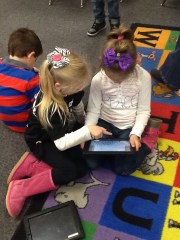
girls working

Today, we will do exciting new things.  Let’s get to it!
Being an Agent of Change

Any growth requires a temporary loss of security.-Madeline Hunter

IMG_1578I’m on spring break and the most productive thing I plan to do today, besides write this post, is to drink my coffee.  Don’t judge…this coffee isn’t going to drink itself.

I’ve been crazy busy the last few weeks and this week off will provide some much needed rest.  I spoke at an education conference in NC, had an Apple site visit and am preparing to speak to some future educators later this week. Oh, and I was teaching too.  Busy, but a good kind of busy.

As I prepare to speak to these future teachers later in the week, I realize they are preparing to enter into student teaching soon.  They will be going into schools with an excitement about teaching and learning.  In many cases, they will have an arsenal of technological tools, including iPads, at the ready.  What a dynamic time to be entering the education field.

I started thinking about what happens when these young people enter a classroom with a supervising teacher who is less than enthusiastic about the use of iPads…or any technology for that matter.  This can be a tenuous situation. How do you tackle a situation where you are expected to be the “teacher” in the classroom but you aren’t really in charge? How does the veteran teacher step into a role as mentor to this young educator when the younger person has far more technological background?

I was approached by a veteran educator after my presentation last week in NC.  She was excited by the possibilities of iPads from my presentation, but was very anxious about the actual implementation. The big picture looks heavenly, but the devil is in the details.IMG_1537

Whether you are a student intern treading softly in a classroom that isn’t your own, or a veteran teacher feeling like an alien in a world that has previously always felt comfortable, change and growth always require some discomfort.  Baby steps and true reflective practice will ease the transition.  For veteran teachers, you are still necessary and relevant…more so now than ever.  You have invaluable experience and wisdom.  By implementing iPads along with your wisdom and experience, your teaching will be transformed.  For the upcoming educators and new teachers, you are still necessary and relevant…more so now than ever.  Your cutting edge technology skills will serve as role models for your students and fellow colleagues.  You will be leading a technological revolution in your schools.

So, with all of our collective bravery, let’s go forth and be the change we seek.  Y’all go on ahead…I will catch up after I finish my coffee.

Today, we will do exciting new things.  Let’s get to it!

Come See Us!

Intellectual growth should commence at birth and cease only at death-Albert Einstein

group pic collageIn a recent post, I talked about raising the bar with iPads.  One of the best ways to raise the bar in education is having teachers learn from each other.  By seeing what is possible…truly possible, one can return to the classroom with a renewed sense of energy and purpose.  It is one thing to hear about something, but it is another thing entirely to see it in action.

My school, Drayton Hall Elementary, is an Apple Distinguished School.  We host visitors from all over.  These site visits have been very beneficial to those who have come.  Apple is hosting 2 such tours at Drayton Hall in the coming weeks.  The first one is March 28th and there is still space available on that tour.  The second tour is April 16th from 8:30-11:30. Click here to see the invitation. Drayton Hall April 16th

I’ve talked about the importance of kids learning from each other and it’s no less important for adults to continue to learn as well.  We have had teachers, administrators, board members and technology folks visit.  They have seen 1:1 iPads across all grade levels and across the curriculum working to personalize learning for our students.  When you can come away from a learning experience as a teacher and take it back to your classroom, the ripple effect has begun…not just with your students, but with your colleagues and their students.team work

Have you ever been to a workshop or professional development and walked away with a new idea?  It is an exciting feeling to try something new and fresh.  As an Apple Distinguished Educator, I am connected to some of the best educators in the world.  As they share what they do, I find myself raising my own expectations and in turn, raising the bar in my classroom.

Many of my readers live in other countries and I realize a site visit isn’t very realistic.  However, make a point to find a way to connect with other educators.  Twitter is a great place to build a professional learning network.  Teaching is hard enough…connecting and learning from others makes it worthwhile.

As we say in the South….y’all come!

Today, we will do exciting new things.  Let’s get to it!

Raising the Bar with iPads

If you’re the band leader you ask more of yourself than anyone else, so they tend to raise the bar for me.-Kristin Hersh

If you look up the definition of the idiom “raising the bar” you will find it means to set a higher standard for people to follow.  Leaders in education are looking for innovative ways to improve student achievement by raising the bar.

H and A under tableA growing number of state and local leaders are working to redefine education in the 21st century, embracing technology and implementing creative reforms that help students customize their education. Initiatives such as blended learning, online classes, and virtual schools allow parents and educators to move away from outdated, ‘one-size-fits-all’ coursework and instead personalize curriculum to meet students’ unique needs. This is a hard shift for many who have difficulty with change or who see no reason to change.

iPads have changed the landscape of teaching and learning.  The ability to research, create, read, write and expand using these tools looks different for each child if done correctly.  I recently read an article that explored the effect of iPads on student achievement.  There was no disagreement on the engagement of students, but there were mixed thoughts on the achievement.  One teacher said the iPads take up too much of her time and she only uses them in her high school classes a few times a month.  (Wait, What?)

Whatever technology you incorporate must be a part of your curriculum.  It’s not about the apps.  It’s not about having iPad time. When adults in the workplace work on a project or assignment, they have the “what”.  They then must decide the “how”.  You look at the job and decide what tools are necessary for completing the job.  Back in the dark ages when I was in college, we hand-wrote every paper that was turned in.  Now, a handwritten essay won’t even be considered and it is turned in electronically.  Our students today will be entering the work force in the future.  They have to learn how to look at a problem and decide the best tool for solving it.

If we wait until iPads in classrooms raise every test score then they will never be purchased.  This is not a magic bullet.  We still need quality teaching and best practices.  The iPads enable us to raise the bar by meeting individual student needs…but only if the teacher empowers his/ her students to take charge of their own learning.

My grade level team works together to reflect and change. We have high expectations for our students.  They help me raise the bar in my own teaching.  How are you raising the bar?

Today, we will do exciting new things.  Let’s get to it!
Some Days are Like That

The greatest sign of success for a teacher is to be able to say, “The children are now working as if I did not exist.” -Maria Montessori

For the record:  Heloise does not have a helpful hint for the best way to remove vomit from an iPad.  Being faced with this very dilemma recently, I realized I had no lifestyle guru to turn to for help.  I just had to push up my sleeves and get to cleaning it.  Into every kindergarten teacher’s life, a little vomit (or other body fluid) must fall.

Some days are like that…a lesson bombs on the same day your principal comes to observe, whining and tattling rules the day, no one seems to be listening, and someone vomits on an iPad.  The best part of those days is when they are over.  A recent visitor to my classroom marveled at how well behaved my students were and how they were so independent.  She noticed they do not interrupt me when I am teaching small groups.  She asked if they were like this all the time or just because there are visitors in the room.  I replied that most days they are independent and well behaved.  I work diligently in the beginning to make them as independent as possible.  Personalizing their learning and giving them the voice and choice to make their own decisions about their learning is a big part of creating that independence.  However, we all have days that are not stellar.

IMG_0366Recently, we were having so many problems with kids not getting along we re-visited our Code of Cooperation.  We discussed where we were falling short and what we could do to correct the situation.  We talked about what each of our agreements would look like.  What does it look like when we listen to others?  What does it look like to be nice?  After our discussion, the children made a Pic Collage to demonstrate their understanding of what our Code of Cooperation should look like.  Here is an example:

HREF

While this won’t solve all of the world’s problems, it helps from time to time, to re-visit expectations and reconnect with what we are about.  It helps us as teachers to return to our fabulous selves and remember that, while “vomit” happens, tomorrow can be a better day.

Here is a great video for when you have one of those days:

Today, we will do exciting new things.  Let’s get to it!

Technology Infused Classrooms

The love of learning, the sequestered nooks,
And all the sweet serenity of books.- Henry Wadsworth Longfellow

Luc landformsWhat does a technology-infused classroom look like?  If it’s done correctly, the technology becomes invisible.  It is seamless.  The teacher scaffolds and creates a curriculum-based lesson, then steps back and allows the students to make the magic.

In my classroom, I’ve  intentionally modeled procedures and through the gradual release of responsibility, my students are independent during their work time.  I’m not interrupted while teaching guided reading groups as students incorporate peer collaboration into their skill sets.  Once my students have learned how to use their apps, they are able to then demonstrate their learning in a creative way they choose.

It is not uncommon to see students in the reading center reading eBooks on their iPads asElla making a book well as regular paper books.  At the writing center, there will be children making books in Book Creator as well as writing out long hand on paper.  Ella, pictured at right, chose to skip her free choice centers today to go write a book on her iPad.  On Monday, she chose to write about her weekend news during Writer’s Workshop.  She wrote 6 pages on lined paper.  Her method of delivery differs but she is demonstrating the skills

With a technology infused classroom, students can make their own decisions.  They are engaged and motivated.  In kindergarten, the infusion is slow and deliberate.  It becomes a natural part of our every day routine so that we don’t have to work at it.  We don’t have “iPad time”.  It an extension of our learning. We don’t just add technology and stir.  We use the technology for information, research, collaboration and creation of products.

By being deliberate, having a plan, and empowering your students, creating a technology infused classroom is easy.

Today, we will do exciting new things.  Let’s get to it!

Technology for Today and Tomorrow

If we teach today as we taught yesterday, we rob our children of tomorrow. -John Dewey

My husband decided he needed an iPad for work.  This decision seems fairly innocuous considering the prevalence of this tool in the modern workplace.  What makes this decision remarkable to me, is that he is a reluctant technology adopter.  He doesn’t have an ATM card, he only recently got a smart phone and he isn’t overly interested in trying new technological things.  He has never used an Apple product nor has he used any touch screen device.  And he is just fine with that.  He leaves those things to me.  I was thrilled with his decision and we immediately went to the Apple store and bought him an iPad.

After it was all set up, I was ready to spend the afternoon with him showing him all of the amazing things the iPad can do.  He puttered with it for about 15 minutes and said he was done for the day.  WHAT?  We barely go past turning it on and off, navigating a few apps and he was done.  Baby steps.

Unlike our students, many adults tread cautiously into the world of technology.  My 5 year old kindergarten students watch me demonstrate (just once) a complex set of instructions requiring multiple apps to complete an assignment and they are on it.  Solo.  To my tiny digital natives, I am speaking their language.  To many digital immigrants, I may as well be orbiting Jupiter and speaking Juptonion.

Could this be part of the reluctance of many adults who are in charge of making technology decisions for schools?  A friend of mine posits that perhaps the simplicity is confusing.  Unless we see the value of technology in our own daily lives, it is difficult to find value in it for our students.  “Why do we need to spend all of that money on iPads?”  We have to move beyond being just fine with the way things were.   We speak about 21st century skills and 21st century classrooms as if they are something out of the Jetsons.  We are 13 years into the 21st century people.  If not now, when will be the right time?

By establishing our classrooms as a global learning communities, students and teachers learn together from each other and from a world of other learners.  Teachers no longer need to have all of the answers.  This revelation frees us up and takes the pressure off…we can explore and learn from our students.  I learn from my kindergarten students almost daily. We don’t need to employ the “no pain, no gain” axiom in teaching and learning.

Here is a video compiled by a colleague showcasing some great things at my school…no adults were harmed in the creation of this video…. 🙂

Today, we will do exciting new things.  Let’s get to it!

It’s a New Day…I’m Still Me

Every new day is a once in a lifetime event. How much more exciting would our lives be if we embraced this truth and lived accordingly?-Steve Maraboli

Tuesday, February 19th was an ordinary day.  School, cook dinner, answer emails and play my new game obsession Candy Crush.  (I can NOT get beyond level 30!) I had checked my email obsessively the last 3 weeks waiting to hear some news, and another day looked as if it would pass without hearing anything.

The email notification on my phone reluctantly pulled me away from attempting to crush those candies.  The subject line was: ADE Class of 2013-United States.  Holy cow…here it was.  The long awaited email.  I was home alone when I opened it and saw the first line: Congratulations and welcome to the Apple Distinguished Educator (ADE) Program.  I stopped reading and started yelling.  My poor dog was certain I had lost my mind.  This application had been turned in since November and the waiting was excruciating.

So what does all this mean? ” Apple Distinguished Educators (ADEs) are part of a global community of education leaders recognized for doing amazing things with Apple technology in and out of the classroom. They explore new ideas, seek new paths, and embrace new opportunities. That includes working with each other — and with Apple — to bring the freshest, most innovative ideas to students everywhere.”-Apple

I’m thrilled beyond words to be a part of this community and can’t wait to learn from the best of the best.  The honor is incredible, but more importantly, the ability to work with some of the most amazing educators in the world is priceless. ADE

Wednesday, February 20 was back to reality.  Still wearing my huge smile and excitement from the night before, it was apparent my children didn’t know the awesomeness of this distinction. They had no idea anything was different from the day before.  Because it wasn’t.  I’m still me.  I’m excited at the new role I will be wearing as an ADE and the possibilities of what new things I can bring into my classroom, but we are back to business.

My kids ask me each day “What will we learn today?”  My answer is always “Today, we will do exciting new things.  Let’s get to it!”

Thanks to all of you for all of the blog and Twitter love!  We have exciting new things to do…let’s get to it!

I’d love for you to leave a comment, subscribe to my blog, and/or share this post with a friend.

Hope Explains More

hom·o·phone : a word pronounced the same as another but differing in meaning, whether spelled the same way or not, as heir  and air.

If you want a sure-fire way to make a class of kindergarten students laugh you need only say “underwear”, “poop” or “naked”.  This will result in uncontrolled, hysterical whooping and laughing.  We recently added the sight word “but” to our list and that immediately created some wide eyes and giggling.  I had added a “bad word” to our list.  What was I thinking?

We immediately launched into a lesson on homophones. This is a complicated concept for my students because they don’t realize words can sound the same but be spelled differently and mean different things.  We came up with a few together on an anchor chart to help them visualize this.  We will add to this as we come across other words, hopefully not as scandalous as “but” and “butt”.

These class conversations combined with the anchor charts help them make concrete connections to otherwise nebulous concepts.  My students are not experts on homophones now, but they have been exposed to the concept and hopefully, with the creation of the anchor chart, it will cause them to stop and think when confronted with another word that is confusing.

In a recent post, I extolled the virtues of our Explain Everything app. One of my students, Hope, was very articulate in her explanation of her annotated illustration.  Hope was vexed by the whole “but” “butt” issue and wanted to Explain Everything about these words that was creating such consternation in our classroom.  Please allow Hope to explain more:

I’d love for you to leave a comment, subscribe to my blog, and/or share this post with a friend.