Daring To Ask “What If”

When the time came to leap in faith, whether you had your eyes open or closed or screamed all the way down or not, made no practical difference.- Lois McMaster Bujold

what ifWhat if?  At times, it is a question posed with wonder and inquiry.  Others, with anxiety and trepidation.  When asked in the hearts of  5 year olds,  it is often met with unconditional enthusiasm and willingness to try.  How do you feel about the “What ifs” in your life?

This has been a challenging year for me both personally and professionally.  In August, I was asked to consider applying for Apple Distinguished Educator.  My first thought was, “What if I don’t make it?”  Then, I allowed myself to think of “What if I do?”  Upon being chosen in February, my professional life changed almost instantly.  I have felt like a meteor hurtling through space…but in a good way. I have been brought into a whole new world of learning, collegiality, and absolute wonder.

I have watched my students daily ask themselves, “What if…” in their learning.  5 year olds are curious no doubt, even without an iPad.  The iPads have allowed us to explore that curiosity, touch it, read about it, talk about it, and create.  Having access to this seemingly simple tool has expanded their classroom beyond our four walls into a global classroom.  The ability to have choice in how they demonstrate learning has awakened even the least confident child and brought him into full flower.  Allowing my students to work at their own level with different sight word lists and reading levels has allowed them to go further in the last 180 days than they ever would have previously.collaboration 2

When I received the opportunity in January, 2011 to utilize 1:1 iPads in my classroom, I dared to ask, “What if?” Over the next few months and into the school year 2011-12, my “what ifs” grew and my students started asking their own ‘what ifs”.  What if I taught my students how to blog?  What if I moved away from the drill and practice apps and allowed my kids to create their own content?  What if I had different sight words lists and allowed them to move on when they were ready? What if I gave them the ability to plan their day and have some choice?

Who knew that just 2 1/2 years ago, when starting with iPads, I would have transformed my teaching to this extent and my students learning as well?  It amazes me even now.

I am wheeling my iPads down to storage in just a few hours as we close the final chapter of the 2012-13 school year today.  I am excited about the awesome staff development opportunities I have with my Apple Distinguished Educators this summer.  I can’t wait to see what new “What ifs” develop in August…well, after a summer vacation, that is…

Whether you are starting a new school term on the other side of the world, or ending this one, I dare you to ask “What if?”  Like the quote above says, whether you take a leap of faith or go screaming all the way, it makes no difference.  The difference comes in daring to try.

Today we will do exciting new things. Let’s get to it!

End of the Year Wrap Up

Waiting makes me restless. When I’m ready, I’m ready.-Reba McEntire

monster“Mrs. Meeuwse, my brain and my butt feel all jiggly.”…  And can’t we all relate to that? We have 7 days of school remaining and these kids are ready.  In fact, I’m not sure if the dinosaur drawing to the left is really a dinosaur or a portrait of me the last few days.  I may or may not be a little cranky…

To be sure, we are continuing our daily routine as much as possible for as long as possible.  We are busy readin’ writin’ and ‘rithmaticin’ daily.  The problem is these brilliant kindergartners are-Caps Lock- DONE,  ready to move on, needin’ to bounce, DONE.

So, in order to preserve my sanity, I came up with the idea that we needed to work on a project.  An end-of-the-year-what-have-I-learned project.  The idea was well received and they quickly wenthope and ella to work sketching out their plan.  They still like to make their plans on paper.  They have the choice of how to present their project.  Some are choosing Explain Everything, some, iMovie, some Book Creator and some Pic Collage.  I needed to intervene only once…a loud chorus of “None of your business!” rang out from a group of girls working together when a rogue boy intruder came by to see what they were doing.

Waiting makes me restless.  It definitely makes 5 and 6 year olds restless. When they are ready, they are ready. What better way to wrap up the year, than to have students share what they have learned?  Some are still working on their projects and it may go on through the week.  Here is one group that made an iMovie. They planned out their script and did it all themselves.  They are already talking about what they want to add to it. They said this is their “rough draft”.

We will have a sharing time so that all groups can show their work.  Some chose to work by themselves on the project and that’s ok too. Sometimes you feel like a nut, sometimes you don’t.  What matters, is that even up to the end, we are working together and students have the ability to choose. When teachers find ways to nurture these inner motivational resources, they adopt an autonomy-supportive motivating style.

All of that to say…the count down is on.  The natives are restless and we need to stay busy.  An end of the year project is just what we need to get us through the crazy.

Today we will do exciting new things. Let’s get to it!

Time To Call An Expert

In learning you will teach, and in teaching you will learn-Phil Collins

Under phylogenetic taxonomy, dinosaurs are usually defined as the group consisting of Triceratops, Neornithes [modern birds], their most recent common ancestor (MRCA), and all descendants.  It has also been suggested that Dinosauria be defined with respect to the MRCA of Megalosaurus and Iguanodon, because these were two of the three genera cited by Richard Owen when he recognized the Dinosauria.

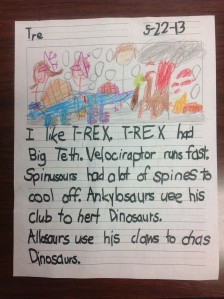
IMG_0484Um…what?  I am no expert on dinosaurs. I know enough to get by, but I am completely unimpressive to Tre.  Tre is my in-class dino-phile.  He knows all, and I do mean all, about dinosaurs.  He has tried hard not to look at me condescendingly this week as we learn about these “terrible lizards”.  Tre has written about, talked about, read about, and drawn about dinosaurs this whole year.  You can imagine his bliss as we all focus on them this week.

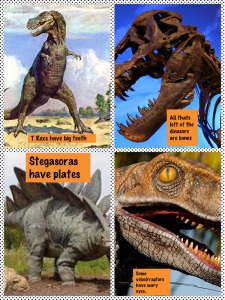
IMG_0482While a lot of my students are knowledgeable about dinosaurs, there are a lot of misconceptions.  It is hard for them to comprehend that dinosaurs pre-existed humans. We are learning from our work and we are learning from each other.  As always, we have voice and choice in our learning.  Tre chose to write about dinosaurs (above) on paper.  Another student chose to make a Pic Collage (at right).  Others chose to make an Explain Everything.  (see bottom of page).

Dinosaurs are always a topic of great interest.  Using  surveys at the beginning of the school year is a good way to find out about your students’ areas of interest.  This makes them part of the curriculum planning process and part of the decision-making process in their learning.  In the learning community of this classroom, the students learn from me, I learn from them, and they learn from each other.  We all have expertise in something and by giving Tre the opportunity to shine this week, he is buoyed by the confidence of his classmates.  My students all know who to go to as the “Expert” of various things in our class.  This gives my students responsibility, buy-in, leadership and best of all…it forces them to work on solving their own problems rather than coming to me all the time.

I’ve said before that the Explain Everything app is awesome.  (Created by a fellow Apple Distinguished Educator). It really gives you a sense of what a child is thinking when they have to explain their thinking.  Here is Hope, explaining everything about dinosaurs. She is definitely one of my class experts on this app.

In what area(s) are you an expert?  Do your students know who the experts are in your classroom? Do student interests help drive your curriculum choices?  All of these are good questions to reflect on as many of us are ending the school year.

Today we will do exciting new things. Let’s get to it!
We “Arrr” Taking Charge Of Our Own Learning, Mateys!

I am not a teacher, but an awakener.-Robert Frost

Seriously, could the end of a school year be any busier?  Lists and lists of things to get done in the remaining 15 days.  As badly as I need to do those things, I still have the small matter (ahem) of teaching these kids who just keep showing up.  🙂

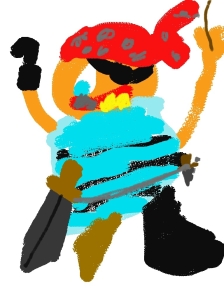
pirateOne of the small joys of teaching little people is their seemingly endless curiosity.  We have extended our ocean unit into a week on Pirates.  They have tons of questions about them.  Living in a city rich with pirate history allows me to share some of the stories of Blackbeard and his time here in Charleston.

My students have loved looking at pictures of different Jolly Rogers and even creating their own.  One group worked on creating their own treasure map after researching different ones online.  They discussed the “necessary components” including the compass rose, the “X” that marks the spot, the need to put the treasure in a safe place and how to find their treasure by marking the “paces” on the map.  These mini mateys collaboratively researched and created their map.

We have a list of “must-do” activities each day and a list of “may-do” activities.  The children schedule their day with their planning sheets.  Part of their “may-do” was to create the treasure map.  There were no specific guidelines and it was their own decision to work together.

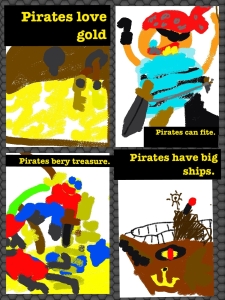
My role as facilitator has enabled me to watch them make their own pirate pic collagedecisions and problem solve both individually and together.  One student created a Pic Collage to demonstrate some pirate vocabulary words.  He drew the illustrations in Doodle Buddy and imported them into Pic Collage and then added his sentences.  During the time students are working on their individual plans for the day,  my assistant and I are able to work with small groups, have student conferences and assess if needed.

Watching my students planning their day, working together with others, solving problems and making decisions about their own learning, I know they are ready to sail to first grade.

Today we will do exciting new things. Let’s get to it!
Reaching Different Learning Styles With The iPad

We learn to do something by doing it.-John Holt

I’ve been teaching myself Spanish.  I’ve used a variety of methods, including Rosetta Stone.  All have taught me some good basic Spanish; however, nothing has helped me more than having actual conversation in Spanish.  Well, conversation may be a bit overstated…I’m ok as long as the other person speaks very slowly and we only use the present tense.  It’s definitely a process.

How do you learn best?  For me, it depends on what I am learning.  Sometimes I need to take notes, other times I need to think out loud.  Some things are easier to learn with another person while with other things, I need to be alone.  My guess is most of us have different styles for learning depending on what it is we are working on.

Our students are no different.  They all learn different things in different ways and at different rates.  Kids today learn from a variety of sources.  They learn from television, peers, computers, video games, and social media.  Technology in our classrooms allow our students to explore different approaches to learning.

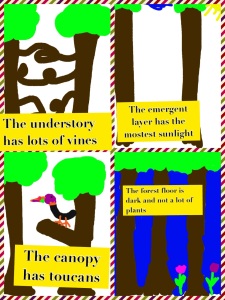
We have spent some time learning about the rainforest.  I recently blogged about how my students use planning sheets to map out their day and their learning experiences.  To share some of their knowledge gained about the rainforest, my kids chose which creation app to use and then demonstrated their knowledge through the iPad. Below are ways 2 different children chose to share with me what they have learned.

rainforest pic collage

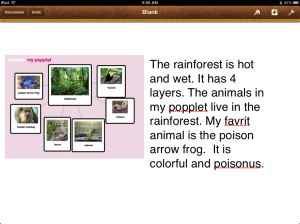
popplet rainforest

One child chose to use Doodle Buddy and Pic Collage and the other chose to make a Popplet and import it into a Pages document. Other students in my class chose different ways.  A few chose Explain Everything, a few chose Book Creator and some chose to use drawing paper, crayons and pencils.  When students have choices they see themselves as participants and contributors to their own education.

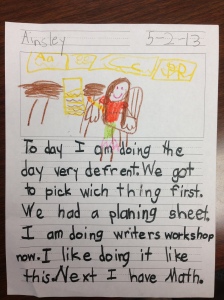
My students, even in kindergarten, like the ability and the responsibility of making these choices about their school day.  Some of the choices given to them are “must-do’s” and some are “may-do’s”.  One child wrote about planning her day in Writer’s Workshop.

PL writingMotivating students to achieve can be difficult in this hyper-paced world.  Giving students choices to work and learn in the manner that best suits them makes them stake holders in their own education.  One of the best ways to learn something is by doing it.  Let’s go for it!

Today we will do exciting new things. Let’s get to it!
What is Your Super Power?

We are what we repeatedly do. Excellence, then, is not an act, but a habit.-Aristotle

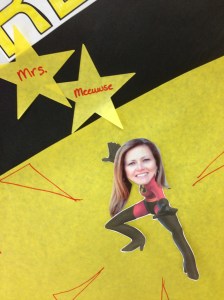
When wsuperheroas the last time you were an action figure Super Hero? I ask, because I am apparently one today. It is Teacher Appreciation Week and my room mom decorated my classroom door with pictures of my assistant and me dressed as The Incredibles. It was particularly exciting to my kids to see us on the door like that…and I must admit, I’m kind of digging the whole super- ripped, super hero body going on there.

I’m not a Super Hero in real life, nor do I play one on tv, but there are times when we must don our Super Hero apparel and create magic in a classroom full of young children. Engaging students today is no easy feat. There are many things that compete for their attention. Even with iPads, there are times when I look around my classroom and wonder what planet I just landed on because those children are NOT my students!

I find when I am using our creation apps (Explain Everything, Educreations, Pic Collage, Book Creator, iDiary, etc…) my students are far more engaged and tend to become mini-super heroes themselves. Their work is better, the content is deeper, their conversations are richer. These are not mindless apps that keep children occupied like a video game. They start with a blank canvas and end with a brand-new creation that wouldn’t have been possible without the technology. This blank slate-to-masterpiece approach, has transformed our classroom and how we learn. We are working on the habit of excellence.

Thomas2My kids love to learn and they love to create. Yes, Thomas is under the table working on his masterpiece. He likes it there because he can work undisturbed. Look at his face.  Is there any doubt he loves what he is doing?

Happy, engaged children make this Super Hero pretty happy. Creating the habit of excellence starts on day one in your classroom. Examine your classroom and see if you have created a habit of excellence.

What are your super powers?

Today we will do exciting new things. Let’s get to it!
My How You’ve Grown!

Without continual growth and progress, such words as improvement, achievement, and success have no meaning.-Benjamin Franklin

Recently, I saw a former student from my kindergarten class 20 years ago.  Talk about feeling old…she was very sweet and told me I hadn’t changed a bit and that I looked exactly the same.  I’m not sure if you can count some wrinkles, gray hair and a few extra pounds exactly the same but I’ll take it.  However, even if I look the same on the outside, I’m definitely different on the inside.

The way I look at teaching and learning has changed.  Obviously over a career span of 24 years, change is expected.  But some of the most significant change has come in the last 2 years as I moved into the role of a facilitator and my students began taking charge of their learning. Through the systematic implementation of the reading and writing workshop approach and by infusing the classroom with the technology from the iPad, my students learn from each other and from a range of collaborative experiences.

This year, I’ve focused on students creating content through a variety of apps and personalizing their learning by giving them choice in these apps.  What this has done has given my students freedom in  demonstrating what they know.  In addition, because they have freedom of choice, they are more engaged and they are retaining more information. Re-teaching skills has been replaced with students collaborating with each other and learning to problem solve together.

Life is messy and not all problems are solved with a “one correct answer” response.  Part of my change and growth has come in allowing my students to grapple with problems on their own or in a group and having them see that not all problems are solved all at once. Working collaboratively helps develop interpersonal skills.  Having choice in their activities, students are working on self-direction. By having students use iPads to create content, they are constructing new knowledge.

21st century learners need to be able to solve problems, and think critically, creatively, and systematically. 21st century educators have to be able to provide their students with the opportunities to put these skills into practice.  In order to do that, we have to be willing to grow and change with our students.

Today we will do exciting new things.  Let’s get to it!
Directions At Their Fingertips

Read the directions and directly you will be directed in the right direction. -Lewis Carroll

I know there are a million jokes about a certain gender  *ahem* not wanting to stop and ask directions.  I am one of those people who don’t like to read the directions.  I tend to jump right in and when all else fails, I read the directions….and if Dr. Phil were asking, I would have to answer that hasn’t always worked out so well for me.

Our students need directions all day and they look to us for them.  Sometimes they need those directions repeated once and sometimes multiple times.  It can be difficult to fulfill that need when there are others who also need your time and attention.  Part of personalized learning, however, is giving them what they need, when they need it.

I’ve started recording directions with my iPad for each of my literacy centers and putting them in a book in the Book Creator app. This week we have been learning about the Rainforest.  I created a video for my vocabulary center, journal center, reading center and word work center.  These are then put in Book Creator.  I named it Rainforest Centers and saved it to the Box App.  My kids go into Box and save it to their iBooks.  The directions are there for them whenever they need them.  They can put their ear buds in and listen as many times as they need.  The best part for me is twofold: 1. They don’t have to interrupt me to ask for directions and 2. Once the book is created, I can reuse it next year if I want.

Ultimately, my plan is to create 2 or 3 sets of directions for each center to benefit students working on different levels, high, medium and low.  Each group would have different directions depending on their abilities.  These direction books could also be created for math as well.

I chose Box because this required the fewest steps for my kindergarten students to complete to access the videos on their own. After all, it is meant to be done without my help.  Another ADE friend of mine in Maine uploads her videos to You Tube and creates QR Codes.  However you choose to do it, simplicity for younger students is a must.

So, while I am working on trying to be better about reading directions before doing something, my students can benefit from having directions at their fingertips whenever they need them.

Today we will do exciting new things.  Let’s get to it!
Organizing for Writing on the iPad

Why do anything unless it is going to be great? -Peter Block

We have been learning about the rainforest and my students are excited and engaged in learning all about the animals in the various layers.  Recently, the students wanted to write about the rainforest and they seemed to be having trouble narrowing their focus.  Someone said, “My brain is all busy with so many animals.”

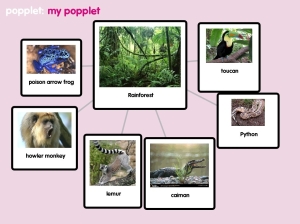
poppletAs adults, it can often be overwhelming as we try to process large chunks of information.  I have to make lists or use sticky notes to keep it all straight.  We all have different strategies for managing the information and processing it.  Young children need to be taught how to organize themselves and their thoughts for writing.

One of the apps we use as a visual organizer is Popplet LiteIt is a free mapping app that allows you to brainstorm and capture your thoughts quickly.  The full version of Popplet is $4.99 and offers many other options, including online collaboration, however, the lite version is just fine for our uses.  The popplet above, was created by a student to help her organize her thoughts on writing about the rainforest.  She saved that to her camera roll and then imported it into Pages to write.  pages and popplet

This is her first page of writing.  She wants to add a new page for each of the animals shown in her Popplet.  By adding the Popplet to her Pages document, she now has a visual reminder of what she wants to write about. She can just continue to refer back to it.

Each child had a choice in how they wanted to share their knowledge.  Some choose Book Creator, some chose Pic Collage and some chose Pages.  They all went on Safari and found the images they wanted and saved them to their camera roll.  They also had a choice to organize their pre-writing thoughts in Popplet or on paper.

Because they have choice in this activity, they are very engaged and excited to share with each other what they’ve learned.  The finished products will be reflective of their creative energies and knowledge gained.  It will be far superior work than if I had dictated how and what they would do…after all, when they have choice, they take ownership.

If we are going to ask our students to demonstrate what they know, it should be in meaningful ways so that in the very act of demonstration, they are extending their learning.  Getting organized is a great place to start!

Today, we will do exciting new things.  Let’s get to it!
Running Records on the iPad

Not all readers are leaders, but all leaders are readers.-Harry S. Truman

Powerful teaching happens when teachers take information gained from observations and assessments of children’s literacy development into consideration when planning instruction.  Since observations can be subjective, it is important to include data from more formal observations as well.

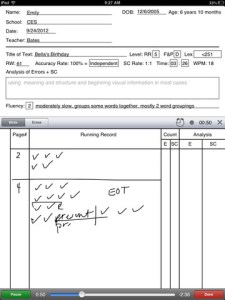
We use running records as assessment tools to assess students literacy progress.  A running record is a tool for coding, scoring and analyzing a child’s precise reading behaviors. (Fountas and Pinnell).  Up until recently, I was using forms from the Fountas and Pinnell kit for running records.  While a great way to take a running record, it requires a lot of copies and paper.

running record imageI have found an app called Record of Reading.  It is a great app…not just because it was created by my alma mater, Clemson University…but because it is an electronic means of assessing reading behaviors.  You don’t need a calculator as it has embedded formulas for accuracy and self corrections.  The app even records the child reading while the teacher simultaneously takes the record. When replaying the record, the oral reading and the record are synced.  The record can be saved or emailed.  There is also a user manual if needed.  You are able to type or write directly in the app and it doesn’t have to be opened in a PDF annotator.  Best of all, it is FREE!.

Running records inform our instruction through capturing progress, assessing text difficulty, matching texts appropriately to students, and seeing and hearing reading behaviors directly.  They also help us group students with similar instructional needs as well as provide individualized instruction where needed.  They give explicit feedback to the student and to parents if needed.

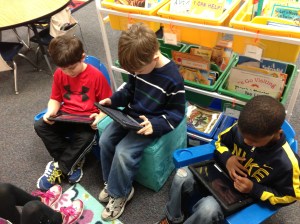
readingWatching my students grow as readers is rewarding.  I love watching them go from non-readers to readers over the course of the school year. Creating successful readers requires knowing your students…knowing their strengths and where they struggle.  It also requires that we know our students’ interests so that we can have texts available to stimulate reading.  By keeping track of our students’ reading behaviors through running records, we can inform our instruction to best meet their needs.

Today, we will do exciting new things.  Let’s get to it!