If we teach today as we taught yesterday, we rob our children of tomorrow. -John Dewey
My husband decided he needed an iPad for work. This decision seems fairly innocuous considering the prevalence of this tool in the modern workplace. What makes this decision remarkable to me, is that he is a reluctant technology adopter. He doesn’t have an ATM card, he only recently got a smart phone and he isn’t overly interested in trying new technological things. He has never used an Apple product nor has he used any touch screen device. And he is just fine with that. He leaves those things to me. I was thrilled with his decision and we immediately went to the Apple store and bought him an iPad.
After it was all set up, I was ready to spend the afternoon with him showing him all of the amazing things the iPad can do. He puttered with it for about 15 minutes and said he was done for the day. WHAT? We barely go past turning it on and off, navigating a few apps and he was done. Baby steps.
Unlike our students, many adults tread cautiously into the world of technology. My 5 year old kindergarten students watch me demonstrate (just once) a complex set of instructions requiring multiple apps to complete an assignment and they are on it. Solo. To my tiny digital natives, I am speaking their language. To many digital immigrants, I may as well be orbiting Jupiter and speaking Juptonion.
Could this be part of the reluctance of many adults who are in charge of making technology decisions for schools? A friend of mine posits that perhaps the simplicity is confusing. Unless we see the value of technology in our own daily lives, it is difficult to find value in it for our students. “Why do we need to spend all of that money on iPads?” We have to move beyond being just fine with the way things were. We speak about 21st century skills and 21st century classrooms as if they are something out of the Jetsons. We are 13 years into the 21st century people. If not now, when will be the right time?
By establishing our classrooms as a global learning communities, students and teachers learn together from each other and from a world of other learners. Teachers no longer need to have all of the answers. This revelation frees us up and takes the pressure off…we can explore and learn from our students. I learn from my kindergarten students almost daily. We don’t need to employ the “no pain, no gain” axiom in teaching and learning.
Here is a video compiled by a colleague showcasing some great things at my school…no adults were harmed in the creation of this video…. 🙂
Today, we will do exciting new things. Let’s get to it!


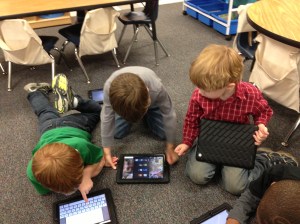



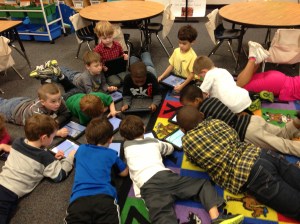 My lesson plans said something completely different. It was unscheduled, unplanned, and… undeniably better than anything I had on today’s agenda. You’ve heard of a Flash Mob? A Flash Mob is a group of people who assemble suddenly in a public place, perform an unusual and seemingly pointless act for a brief time, then quickly disperse, often for the purposes of entertainment or artistic expression. Well, That. Just. Happened. No dancing or singing…this was definitely in the realm of artistic expression. My students were working on their iPads when a group suddenly gathered in the middle of the room and started writing books. This group (pictured above) was fully engrossed in their work. They were discussing book topic, titles, text placement, and content. They stopped briefly, only to ask me to put on some “creative music”. Once they started, they didn’t stop until they were finished. Most had written a 4 page book. Once they finished, they dispersed and went back to what they were doing before.
 iTeach with iPads