Exploring Science

Men love to wonder, and that is the seed of science. -Ralph Waldo Emerson

Young children are curious about the world around them and eager to explore it. This curiosity is reflected in the numerous questions that children pose in everyday conversations at home and in school. However, at the beginning of school, young children are afforded few opportunities to engage systematically and thoughtfully in learning science. On average, less than 10% of instructional time is spent on teaching science in the early grades.  Time is a precious commodity in the classroom…so how do we fit it all in?

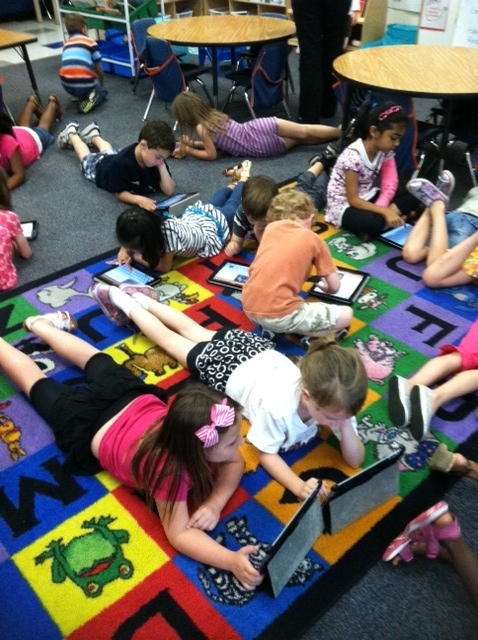
One of the ways we incorporate science is through our thematic units.  We also explore science themes through informational texts.  One of my reading groups was reading a leveled book on weather.  The informational text was written on this group’s reading level.  After reading the book and discussing different kinds of weather, we used our iPads as both a reading response/science journal.  Using our Whiteboard App, the children wrote about weather.  Kaylee wrote about a sunny day.  This was their first experience using the iPad keyboard.  They were excited about creating this assignment on their iPads.  There was a lot of good discussion among the children about which type of weather they would choose and how they would represent that on the iPad. One of the best ways to incorporate scientific skills in young children is to help them verbalize what they have observed.  Doing this activity in the small guided reading group made it very manageable.  The children already knew how to use Whiteboard in its basic form, how to change their colors, draw, erase, and save…but had not used the keyboard function before.  We had to discuss a few keyboard basics-space bar, backspace to erase, and how to hide the keyboard when finished.

Carl Sagan, the famous astronomer and writer, said that all children start out as scientists, full of curiosity and questions about the world around them.  We can tap into that natural potential by engaging students in hands-on activities, and in class discussions that help students discover simple but amazing facts about the world around them. The iPads serve as a tool to facilitate and extend the learning.

I’d love for you to leave a comment, subscribe to my blog, and/or share this post with a friend.

Write This Way

I am a writer. – Jayde, age 6

I’m not a writer. I didn’t go to journalism school and I have no proper credentials that certify me as a writer.  I haven’t immersed myself in the study or practice of writing.  So how can I expect my students to view themselves as a writer if I don’t even view myself as one?

Maybe the problem lies in how one defines “writer”.  I think my perception in the past has been that writers are trained and paid for their work.  Since I’ve been using the Writer’s Workshop approach to writing, I’ve learned that we are all writers.  Writers write every day. Writers share their ideas.  Writers write on a variety of topics and writers are good readers.   As educators, we have to remember that our attitudes are conveyed to our students.  I want my students to be excited about writing.  When I start Writer’s Workshop each day, I call my “writers” to the carpet and I ask them in conferences to share with me what they are learning about themselves as a writer.  In turn, I model writing for them.  I think aloud about writing ideas.  I model what I do when I get “stuck”.  I model writing on a chart tablet and on my iPad.  If I think of a writing idea in the middle of math, I jot it down on a sticky note or in my Notes app.  I tell them to do the same.  I blog here and I blog with them on KidBlog.  We talk about what good writers do and we use mentor texts as examples.

My modeling has been fruitful.  My students write every day.  They write about a variety of topics and for a variety of purposes. They write fiction and non-fiction.  They write stories on paper and on their iPads.  They make lists.  They make books in eBook Magic and on Pages.  They write personal narratives and one even wrote a song. They blog with each other.  They fill one page and ask for another.  And another.

They have no doubt they are writers.  It never occurs to them to think they aren’t. They write and they share. They encourage one another.  They have all the necessary tools.  They have training.  All they need now is to get paid!

Hey wait!  Can I get in on that too?

I’d love for you to leave a comment, subscribe to my blog, and/or share this post with a friend.

Reflecting on Student Growth and Achievement

I was taught that the way of progress was neither swift nor easy.-Marie Curie

Recently, I was looking at photographs taken of my students on the first day of school. They looked so little and baby-faced.  It was amazing to see them then and to see how much they have grown this year.  They are taller and their faces have changed.  Because I am with them all day, every day, the change wasn’t as evident.

The same goes for their work.  They work hard all year and little bit, by little bit, progress is seen.  Several years ago, I started keeping a writing portfolio of student work.  I save a writing sample from each child, each month.  At the end of the year, I put them all together in a portfolio to send home to parents.  It is so wonderful to look through the pages and see the growth that occurred throughout the year.  We start on the first day of school:

Students write their names and draw a picture of themselves.  If they are able to, many will write on or label their pictures.  Each month, growth is evident.  By the end, it will look something like this:

What a difference 9 months makes!  It looks so easy, yet a lot of hard work went into this progress. Many times I ask myself, “Are we there yet?” It takes looking at the beginning to appreciate the end product.

How do iPads fit into this? The iPads were used as a companion in both the Reading and Writing Workshop.  Students used them for reference, for reading, and even some writing.  The apps provided them with practice in reading and spelling, which in turn, helped them in their writing.  Their writing on the iPad has been incorporated into their blogging experience, in their creation of books in eBook Magic and in Pages.  While they tend to write more prolifically on paper, they do enjoy writing on their iPads.  It has also given them some beginning keyboarding skills.

They have had a variety of experiences in using iPads, reading books, class discussions, writing stories, using anchor charts, partner work, and various other literacy-building activities.  The key words here are “variety of experiences”.  When you immerse students in a literacy-rich environment, incorporate a systematic approach to reading and writing, and differentiate instruction with iPad technology, students can’t help but succeed!

I’d love for you to leave a comment, subscribe to my blog, and/or share this post with a friend.

On Safari

I hear and I forget. I see and I remember. I do and I understand-Confucius

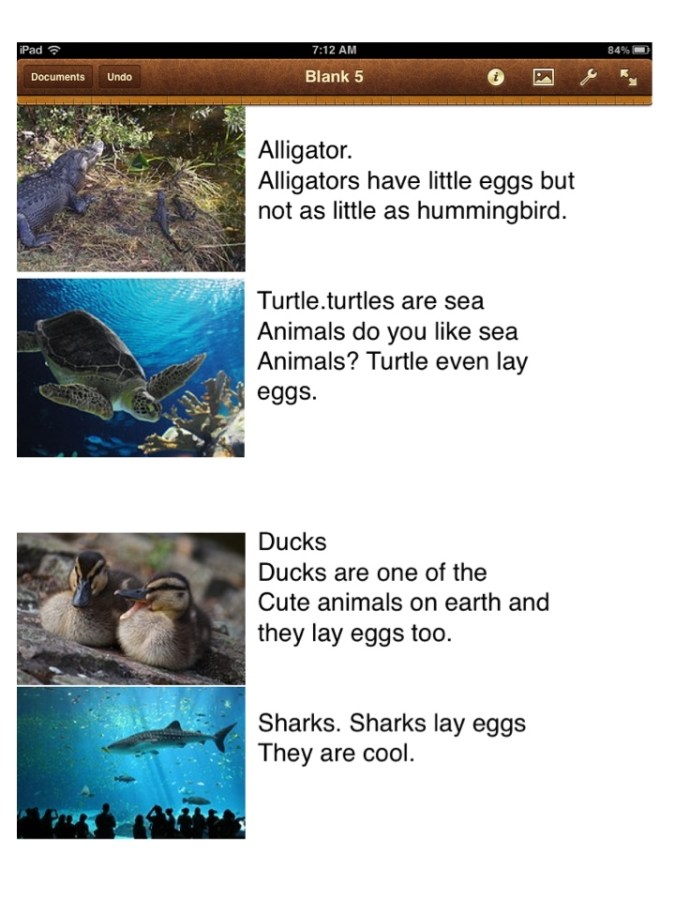
We did it.  We stepped out into the World. Wide. Web.  We have been talking about oviparous animals.  After a class read aloud of the book Chickens Aren’t the Only Ones, the children chose 4 animals that lay eggs. They Google searched the animals and found pictures of them.  Then they saved their images to the camera roll and imported them into their Pages App.  Once the images were imported in, the children wrote about them.  Finally, we shared our projects with each other.  This was our first time to go on Safari.  First, there is the issue of internet safety as children search the web. Second, there is the whole madness of 26 children learning how to search Google and choose an appropriate site and lastly, saving images to their camera photo roll.  This first time, we used Wikipedia for our animal images.

For instruction, I hooked my iPad to my Smart Board and was able to demonstrate step by step how to do things.  The children listened and followed directions beautifully.  As soon as they opened up their Wikipedia pages with images of the animals, the room was filled with Oooh’s and Ahhh’s.  A hush fell over the room and their eyes were huge with wonder. That beautiful Kodak moment was quickly replaced with tons of excited chatter and discussion.  By the second time I had demonstrated how to find the image and save it, the pros were done with me and moving at their own speed.  “Thanks, Mrs. Meeuwse, but we’ve GOT it.”  Teacher dismissed.

My original plan was to stretch this out over 2 days.  I thought on day 1 we would work on learning how to search the web and save our images. On day 2, we would import them in and type our facts.  The children had a different plan.  They were so engaged in this activity that when I suggested we wait and finish tomorrow, their faces fell and they said, “Why?” Why indeed, so we worked on.  They worked for an hour and a half before most all were finished and we shared.  After we shared, they asked, “Can we please do this again tomorrow?” “Tomorrow?” I asked.  “You want to learn tomorrow too?”

These crazy kids….

I’d love for you to leave a comment, subscribe to my blog, and/or share this post with a friend.

The Force is With Us…

In Star Wars: Episode I — The Phantom Menace Darth Maul said, “At last we shall reveal ourselves to the Jedi. At last we shall have revenge.” Well, that didn’t quite work out, did it? At least not then, and certainly not because of the tattooed Sith Lord. Sure, Maul killed the preachy Qui-Gon Jinn, but he in turn got cut in half by Obi-Wan Kenobi.

Huh?  I’m clearly out of my element.  I introduced a new book in our reading center today. It is an encyclopedia of Lego Star Wars characters.  Saying it was a huge hit is an understatement.  The above discussion, or something like it, was taking place today between Hagan and Caleb.  They are my Star Wars experts.  The excitement over this new book was not unexpected.  Interest inventories taken on my students clearly showed the need for this new addition.  However, what happened next was unexpected. In the midst of all of the Star Wars techno-babble, the boys decided it would be great to go to the iPad and write about it.  They planned out what they wanted to each write and how they would illustrate it. The discussion  was amazing.  Their engagement was priceless.

I am passionate about my students’ writing.  We have several author studies throughout the year and I use mentor texts to inspire their writing. It is essential in teaching creative writing to provide opportunities  to link writing topics to who the children are familiar with and to what excites them.  Conferring with the students, having them look at their own writing and sharing their writing helps them make connections with good reading and writing skills.  The use of iPads, in conjunction with systematic teaching in Reading and Writing Workshop,  is producing the most advanced reading and writing that I’ve seen in the 23 years I’ve taught. The data is compelling.

Hagan and Caleb-Star Wars aficionados

Whether the students are writing on iPads, blogging, creating eBooks, or writing with pencil on paper, they are immersed in rich language all day long.

So, whether you side with Darth Maul or Obi-Wan Kenobi, I believe “The Force” is strong in kindergarten!

I’d love for you to leave a comment, subscribe and/or share this post with a friend.

Jayde Talks Blogging

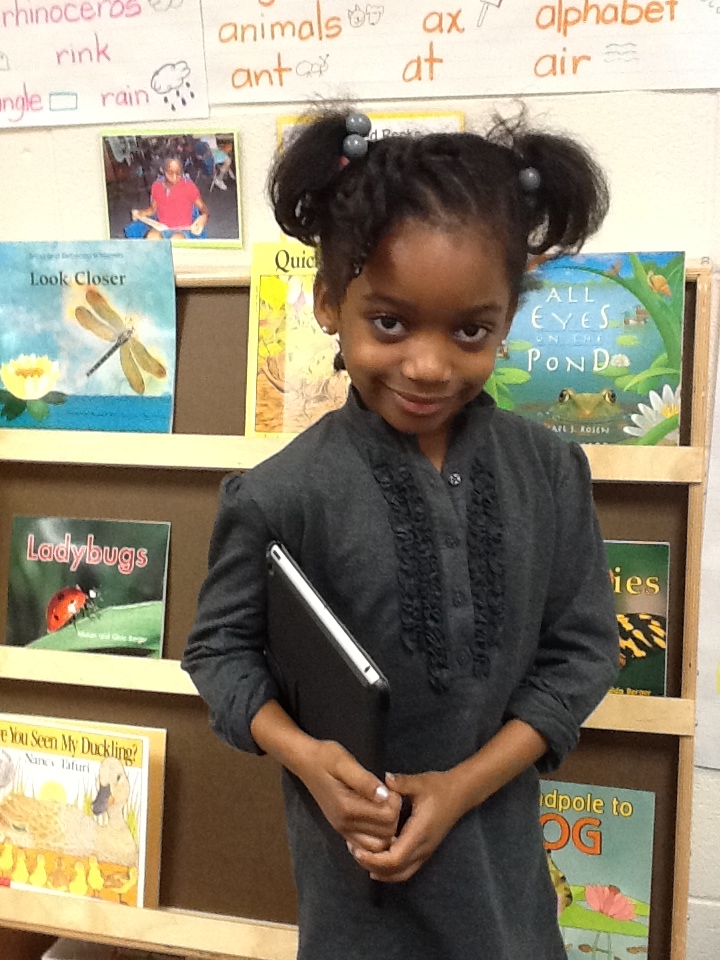
Jayde takes a break from her writing to pose for our picture.

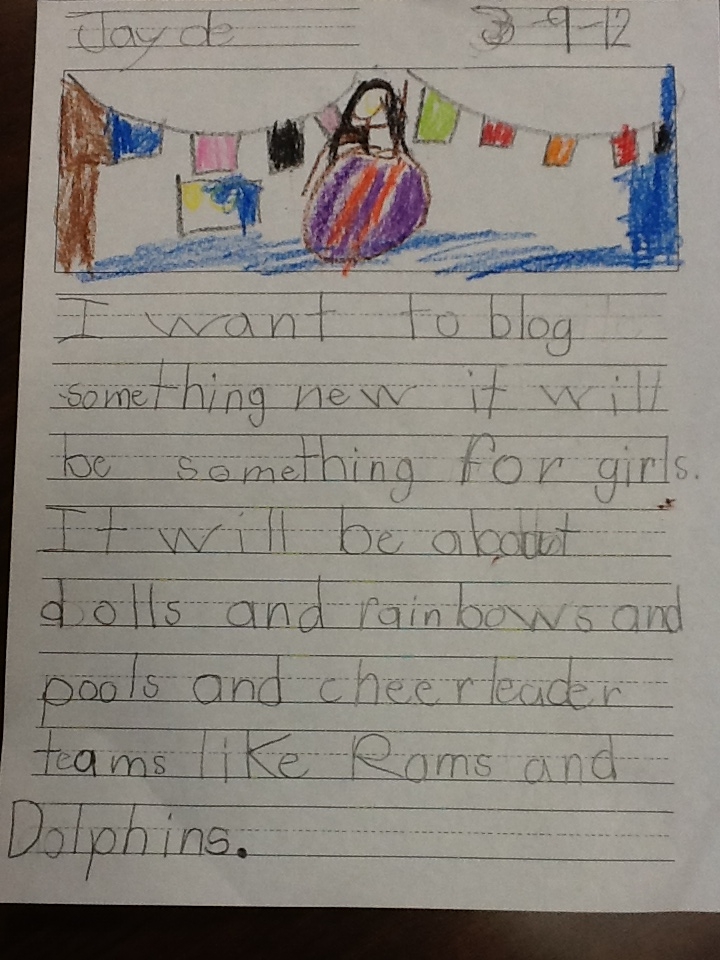
Last week, I posted about my students using their iPads to blog using Kid Blog and I shared a  writing sample from Jayde.  She shared that she wanted to write a new blog for girls.  She included a few topics that she would like to blog about.  What strikes me about this young writer (besides the fact that she is 6 years old) is that she already has a basic understanding of her niche.  Pro blogger states that many writers ask what to blog about rather than how.It further states that niche blogging appeals to readers.

I interviewed Jayde about her blogging ideas.  Here is an excerpt of that interview:

Me: “Jayde, tell me what you like about blogging.”

Jayde: ” I like writing about things I like and I like to read what other people write. ”

Me: “What made you want to write a blog for girls?”

Jayde: “I like dolls and rainbows and I like cheerleading.  I have friends who like those things too. I think other girls like them too.”

Me: “How do you decide what to write about?”

Jayde: “I just think of things I like and what my friends like.  It’s easy.”

Jayde at work.

There it is folks…Jayde knows what it’s all about. French-Cuban author Anais Nin says, “My ideas usually come not at my desk writing but in the midst of living.” It inspires me to know that Jayde and the other students in my class are busy 5 and 6 year olds living and writing what they know.

What inspires you?


It’s Just How We (Blog)Roll…

“Most of the basic material a writer works with is acquired before the age of fifteen.”-Willa Cather

This week, I stepped into the world of blogging on the iPads with my kindergartners.  Through KidBlog students can blog in a safe and secure way. The website states “Kidblog’s simple, yet powerful tools allow students to publish posts and participate in discussions within a secure classroom blogging community. Teachers maintain complete control over student blogs. ”

What could kindergarten students possibly have to say in a blog?  Seriously?  Have you been in a kindergarten classroom?  They ALWAYS have something to share.  This forum allows them to share as much and as often as they like.  Blogging supports writing and reading skills as well as digital literacy.

I showed my students this blog and then talked with them about what they might want to share on their own.  We brainstormed different ideas and then off they went making lists on their iPads of possible blogging topics.  I posted to the class and then had them read and respond to my post first.  Then I had them write their own posts. Next, I had them choose some of their classmates posts to read and respond.  This all happened in one day!  Since then, each day, they are asking me if they can please write in their blogs.  My next step is to connect with a first grade class in our building and become Blogging Buddies.

Obviously, I am monitoring all posts and comments.  I am also posting on the blog site and responding to their blogs.  This modeling is important.  The students get excited when they see I have responded to their blog.

One student’s thoughts about blogging

Blogging is allowing my students to bring their own voice alive in the classroom and construct their own learning.  It gives them an important sense of being a writer.  After all, we are what we think we are.