Building Reading Stamina with the iPad

Believe me, my children have more stamina than a power station.-Robbie Coltrane

Building stamina in young readers is definitely a challenge.  Their attention spans are short and their energy level is high.  It is important to know children well enough to link each of them to the texts that will sustain their interest, and won’t be so challenging they get discouraged.  Every good English language arts teacher knows that immersing students in reading is far more important than teaching test-taking strategies. Many are also familiar with some of the techniques for helping their students monitor their reading throughout a reading task. Some use specific lessons and strategies for helping students maintain focus and gain stamina as they read, but finding the best lessons and other resources for teaching such skills is often time-consuming and difficult, requiring more hours than teachers have for seeking out new material.

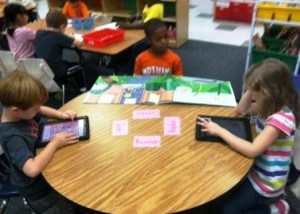
Using iPads has helped increase my students’ stamina even during the short 57 days we’ve been in school.  As students build confidence in reading short, leveled texts, they are more likely to venture into more difficult texts.  I use LAZ leveled reader apps and my own texts that I’ve created in iBooks Author to supplement the reading materials in class.  As students have a few minutes of free time, or they are in the book center, they have high interest texts to choose from on their iPads.  Having these books at their fingertips makes it easy for anytime reading.  Re-reading familiar texts also increases their fluency.

Another way to use iPads in building stamina is to celebrate progress. Without getting too caught up on the number of minutes spent reading, celebrate the time that is spent reading. Share your favorite parts of books read by reading out loud with a partner on the iPad.  Illustrate your favorite parts in the Pages app and share with your writing group.

Spending longer periods of time reading means fewer interruptions and more time reading what you love. iPads provide resources beyond your regular classroom materials to facilitate this.  As your students move into higher grades, having reading stamina will help them navigate the longer texts and assignments.

I’d love for you to leave a comment, subscribe to my blog, and/or share this post with a friend.
Giving Students Choices in Reading

Readers without power to make their own choice are unmotivated. -Donalyn Miller-The Book Whisperer

I’ve stated before that I’m a voracious reader.  I have always loved books and the ability to be transformed by a story.  I particularly love Southern writers.  I’ve never quite understood how others aren’t “readers”. They read only when required and almost never for pleasure.  In order to create readers, we have to identify ourselves as a reader first.  We must “brand” ourselves as readers.  When I read to my class, I share what I like about that particular author. I tell about other books like that book.  I make connections with myself to the text, to others, and to the world.  My students know how much I love to read.

But what about those who struggle? Or those who don’t like it?  Getting to the root helps determine which way to help the child grow.  What don’t they like?  Are there books available that interest them?  How many informational texts are available on their reading level?  I can tell you that as much as I love reading, I would not be as enthusiastic if I were forced to sit and read instructional manuals all day, or books on mechanical things. Those are not my interest.  Taking an interest inventory helps know how to fill your book center or your iBooks shelf on your iPad.  Building an early foundation of excitement about books, whether paperback, hardback, or electronic, helps build an appreciation and love for books.

My students have a variety of genres available throughout the day.  We work to build enthusiasm for our classroom library and for our eBooks on our iPads.  By demonstrating authentic reading behaviors, doing away with worksheets, engaging kids in building stamina when they read, and giving kids choices about what they read, we can develop life-long readers.

Reading is so much more than phonics, sight words, and mechanics.  It is about building discovery, wonder, and awe around the written word.  It is power.  It is peace.

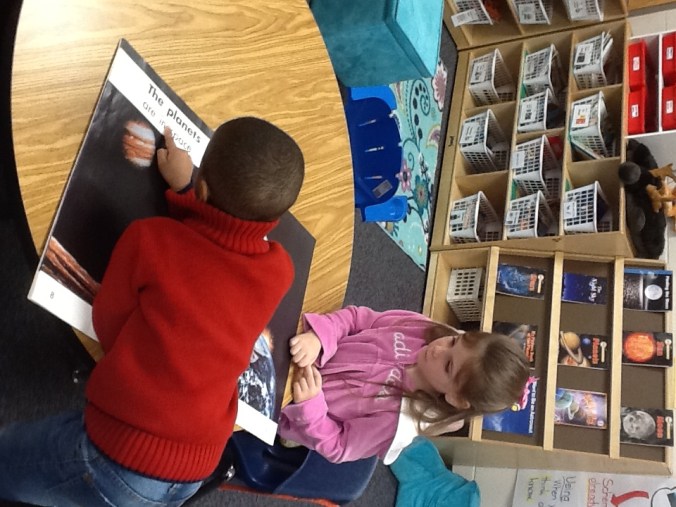
So what should students learn from us about reading?  That drill and practice worksheets aren’t making them better readers.  Reading makes them better readers.  iPads give me the opportunity to practice the mechanics of reading with individual students on their own level, but they also give them a choice of what they are reading.  There are leveled books in their iBooks libraries.  There are high interest books as part of their apps, plus all of the traditional books in our classroom.  The best part of all is that the choice is theirs!

I’d love for you to leave a comment, subscribe to my blog, and/or share this post with a friend.

eBooks in the Classroom

Teaching reading IS rocket science.- Louisa Moats

Have you seen the size of textbooks lately?  Measurements go from about an inch to 3 inches.  Forget portability.  Carrying a load of them will surely result in a trip to the chiropractor.  Enter eBooks.  They are rapidly growing into a popular option with all of the electronic reading devices available.

Don’t get me wrong…I still love reading to my students with a physical book. We get cozy and listen.  We drift off to fun and faraway lands.  We laugh at the antics of our favorite characters and we learn to love reading.  Many students don’t have someone cuddle up with them, to read favorite stories and drift off to sleep to the cadence of familiar words from an oft-read story.  eBooks simply offer options for my readers.  Many ebooks have interactive features and vocabulary support that physical books don’t have.  eBooks are easily updated as information changes.  Our iPads hold many eBooks and enhance the “learning on the go” concept. You can take a virtual library with you.  No trees were cut down to make an eBook.  Another consideration is that many eBooks have accessibility features for English Language Learners.  Some students may find reading on an iPad more engaging than an actual book.  While many arguments may be held over traditional books versus eBooks, I simply want my children to READ and to love reading.  eBooks give us the ability to differentiate.

The Common Core State Standards stress readying students for college and career.  Growing good readers requires a large variety of reading resources. I have spent some time recently with Sylvan-Dell publishers.  They have 70 titles in English and Spanish available in eBook format.  The picture books that they publish are usually, fictional stories that relate to animals, nature, the environment, science, and math. Each book has a “For Creative Minds” section to reinforce the educational component of the book itself. This section will have a craft and/or game as well as “fun facts” to be shared by the parent, teacher, or other adult.  The illustrations are realistic and engaging. The books are great for school purchase or for parents to have at home on their iPads for their children. The books are leveled in a variety of ways to meet the needs of different reading programs.  There is a 30 day free trial with no obligation available.

I am all about engaging minds and growing life-long readers.  Having an arsenal of resources both physical and electronic only strengthens my teaching.  In this day and time, teachers need all the help we can get!

I’d love for you to leave a comment, subscribe to my blog, and/or share this post with a friend.

Focus on Vocabulary: Tiers 1,2, and 3

One forgets words as one forgets names. One’s vocabulary needs constant fertilizing or it will die.- Evelyn Waugh

Is it possible to overstate the value of words?  Our ability to function in today’s complex world is determined by our language skills. We use expressive vocabularies to speak, receptive vocabularies to listen and comprehend, and literate vocabularies to read and write.   A large vocabulary is  reflective of high levels of reading achievement. Yet, often, vocabulary instruction is over-looked in schools today as other skills get pushed to the forefront.

We used the iPads last year for phonics practice as well as vocabulary acquisition.  Our Tier 1 words (sight words), we practiced in several apps, most notably Spelling 1-2 and Spelling Bee.  We worked on Tier 2 words (essential for understanding text, non-redundant words) in Montessori Crosswords and our Magnet board apps.  Tier 3 words (infrequently used, subject specific words) can also be practiced with these apps.  These apps allow for many opportunities to talk about and work with words.

Young students learn to communicate through listening and speaking. As students learn to read, they develop fluency and automaticity through rapidly using decoding strategies.  A large amount of attention in the early grades is placed on high frequency words.  These are very important for emerging readers.  However, it can’t stop there.  We must increase comprehension through the use of Tier 2 and 3 words.  Research is showing that in 4,469 minutes of reading instruction, only 19 of those minutes went toward vocabulary instruction and acquisition.

The most recently released study of international reading achievement provides some strong evidence that the weakness in U.S. student performance is not the result of decoding problems or inability to comprehend narrative texts. Instead, it seems to be due to weakness in ability to comprehend.  informational texts (Progress in International Reading Literacy Study, 2003).  80% of text that adults read is informational.

Through the iBooks Author software, I was able to create a few high-interest non-fiction texts that were on my students individual reading levels last year.  By having these texts on their iPads, they have them handy whenever they want to read.  I have also downloaded the I Like Books app.  It is a collection of 30 (free) non-fiction books.

Through the use of these reading apps and the apps mentioned above for practicing vocabulary, I am able to increase the rigor in vocabulary instruction.

I’d love for you to leave a comment, subscribe to my blog, and/or share this post with a friend.

Write This Way

I am a writer. – Jayde, age 6

I’m not a writer. I didn’t go to journalism school and I have no proper credentials that certify me as a writer.  I haven’t immersed myself in the study or practice of writing.  So how can I expect my students to view themselves as a writer if I don’t even view myself as one?

Maybe the problem lies in how one defines “writer”.  I think my perception in the past has been that writers are trained and paid for their work.  Since I’ve been using the Writer’s Workshop approach to writing, I’ve learned that we are all writers.  Writers write every day. Writers share their ideas.  Writers write on a variety of topics and writers are good readers.   As educators, we have to remember that our attitudes are conveyed to our students.  I want my students to be excited about writing.  When I start Writer’s Workshop each day, I call my “writers” to the carpet and I ask them in conferences to share with me what they are learning about themselves as a writer.  In turn, I model writing for them.  I think aloud about writing ideas.  I model what I do when I get “stuck”.  I model writing on a chart tablet and on my iPad.  If I think of a writing idea in the middle of math, I jot it down on a sticky note or in my Notes app.  I tell them to do the same.  I blog here and I blog with them on KidBlog.  We talk about what good writers do and we use mentor texts as examples.

My modeling has been fruitful.  My students write every day.  They write about a variety of topics and for a variety of purposes. They write fiction and non-fiction.  They write stories on paper and on their iPads.  They make lists.  They make books in eBook Magic and on Pages.  They write personal narratives and one even wrote a song. They blog with each other.  They fill one page and ask for another.  And another.

They have no doubt they are writers.  It never occurs to them to think they aren’t. They write and they share. They encourage one another.  They have all the necessary tools.  They have training.  All they need now is to get paid!

Hey wait!  Can I get in on that too?

I’d love for you to leave a comment, subscribe to my blog, and/or share this post with a friend.

Reflecting on Student Growth and Achievement

I was taught that the way of progress was neither swift nor easy.-Marie Curie

Recently, I was looking at photographs taken of my students on the first day of school. They looked so little and baby-faced.  It was amazing to see them then and to see how much they have grown this year.  They are taller and their faces have changed.  Because I am with them all day, every day, the change wasn’t as evident.

The same goes for their work.  They work hard all year and little bit, by little bit, progress is seen.  Several years ago, I started keeping a writing portfolio of student work.  I save a writing sample from each child, each month.  At the end of the year, I put them all together in a portfolio to send home to parents.  It is so wonderful to look through the pages and see the growth that occurred throughout the year.  We start on the first day of school:

Students write their names and draw a picture of themselves.  If they are able to, many will write on or label their pictures.  Each month, growth is evident.  By the end, it will look something like this:

What a difference 9 months makes!  It looks so easy, yet a lot of hard work went into this progress. Many times I ask myself, “Are we there yet?” It takes looking at the beginning to appreciate the end product.

How do iPads fit into this? The iPads were used as a companion in both the Reading and Writing Workshop.  Students used them for reference, for reading, and even some writing.  The apps provided them with practice in reading and spelling, which in turn, helped them in their writing.  Their writing on the iPad has been incorporated into their blogging experience, in their creation of books in eBook Magic and in Pages.  While they tend to write more prolifically on paper, they do enjoy writing on their iPads.  It has also given them some beginning keyboarding skills.

They have had a variety of experiences in using iPads, reading books, class discussions, writing stories, using anchor charts, partner work, and various other literacy-building activities.  The key words here are “variety of experiences”.  When you immerse students in a literacy-rich environment, incorporate a systematic approach to reading and writing, and differentiate instruction with iPad technology, students can’t help but succeed!

I’d love for you to leave a comment, subscribe to my blog, and/or share this post with a friend.

Developing Strong Readers

“Books are a uniquely portable magic.” ― Stephen King

My students are readers.  They read everything they see. They read books in the reading center, they read books in guided reading, they read anchor charts all over our classroom, they read books in the science center, and they read on their iPads. I model writing each day during Writing Workshop on a chart tablet.  When I fill the tablet, I put it in the reading center for them to read.  It is fair to say, they read in some way all day long.

One of the free apps we enjoy by GrasshopperApps.com is I Like Books.  This is a collection of 37 picture books that cover a variety of topics on things children like, such as, animals, drawing, music, planes, snow, trains, pets, trucks, etc…You can add your own voice by recording the entire story.  There are word highlights, and 3 play-back modes-read to me, read by myself, and auto-play.

The I Like Books App is just one of the reading options we have on our iPads.  In addition to the books I’ve written in iBooks Author that have been uploaded to their iBooks libraries, they have LAZ leveled books, plus other individual books of interest such as Toy Story, Dr. Seuss books, some books by Story Chimes, Little Critter books by Mercer Mayer, and books by Learn to Read. The children have created a few books of their own through eBook Magic that are also available in their iBooks library.

When we immerse young children in literacy-rich classrooms, the foundation of basic early literacy concepts, skills and positive attitudes are developed.  This concept of literacy immersion centers on the idea that children need to exist in a literature-friendly environment. Reading and writing are critical modes of communication in all areas of life.  When we incorporate inter-disciplinary connections to literacy, we increase student success.

Setting up the classroom for literacy immersion is  deliberate and carefully planned.  Children observe the teacher modeling reading and writing, they participate with the teacher in shared reading and writing and they participate in independent reading and writing activities all throughout the day.

As children develop and strengthen their early literacy skills, they are also expanding vocabulary and writing skills, developing longer attention spans, enhancing creative thinking skills, and enhancing their memory skills.

My children would just say they are having fun.

I’d love for you to leave a comment, subscribe to my blog, and/or share this post with a friend.
Great Expectations: Closing The Achievement Gap With iPads

Definiteness of purpose is the starting point of all achievement. -W. Clement Stone

If you search the internet for technology and educational achievement, you will find a variety of opinions as to whether technology impacts achievement in elementary school.  Having taught school through a veritable technology spectrum that ranges from no classroom technology, to having an Apple IIe with no internet connection and a stack of 5 1/4 floppy disks, to 4  networked Dell Desktops and now iPads for each student, I can say the student motivation with technology has always been higher than without.

I’ve stated before that technology without purpose will not yield desired results.   Schilling and Schilling (1999) capture well the broad idea that expectations are vital to education. … the literature on motivation and school performance in younger school children suggests that expectations shape the learning experience very powerfully. For example, classic studies in the psychology literature have found that merely stating an expectation results in enhanced performance, that higher expectations result in higher performance, and that persons with high expectations perform at a higher level than those with low expectations, even though their measured abilities are equal.

In an earlier post, I shared reading results from the 2010-11 school year.  We used iPads from the end of January until the end of the year.  It was exciting to see such growth.  This year, with only 24 school days remaining, our data is equally exciting.

It is interesting to note that I had 2 students transfer in after Christmas as non-readers.  They are currently reading above grade level.  How is this possible? Systematic teaching in the Workshop Model and the ability to differentiate instruction to meet individual student needs on the iPad is the key.  Student-centric technology is the answer to the One-Size Fits All approach to learning.

The larger debate concerning the effect of technology on student achievement goes on outside our little classroom.  I’m not a statistician nor am I a researcher, but when 100% of my students are going to First Grade reading above grade level 2 years in a row, I would say iPads are an essential part of our learning environment.

I’d love for you to leave a comment, subscribe to my blog, and/or share this post with a friend.

Knowledge is Power: Students Taking Charge of Their Own Learning

Research is creating new knowledge.-Neil Armstrong

We have been studying the rainforest.  Kids love animals and the plethora of exotic animals in the rainforest creates instant interest and curiosity.  One day the wonderment and inquiry had reached fever pitch.  “Does the poison arrow frog have any predators?” ” How big is a giant anteater anyway?” “Are howler monkeys nocturnal or diurnal?” And my personal favorite question that was asked, “How does chocolate come from the rainforest?” I started writing down all of our questions so that we could figure out how we would solve them.  Before I finished, someone said, “I think we should look on Safari on our iPads.” Someone else immediately asked if they could “research” rainforest to find some answers.  Do you see the rich vocabulary here?  These questions and statements are not being paraphrased.  This is what happens when children feel empowered to take charge of their own learning. I barely had nodded yes to the research question when my room looked like the start line at the Boston Marathon.  Someone found a website on Safari that had several rainforest animals.  Peer sharing began immediately.  The students started finding images and information about animals that interested them.  They helped each other and they were engaged, focused and excited.  Without me giving any directions…on their own they started saving images and importing them into Pages.  They debated font size, picture size and word choice.  I facilitated, checked-in with groups, answered a few questions and mostly just let them have at it.  Their conversation was rich with the language of inquiry. They worked on this for over an hour before we had to stop. After lunch they came back to it and worked until they finished.  Here is one student’s work that is finished. Keep in mind these children are 5 years old and have no keyboarding skills other than “hunt and peck”.

This lesson was completely student-driven.  It all started with me reading a non-fiction book on the rainforest.  My plan was to go in a different direction but once the questions started, I knew my plan was out the window and we were headed down a different path.  But…isn’t that how it’s supposed to be?  Inquiry-based learning teaches problem solving and critical thinking skills. It develops student ownership of their learning and builds student interest in the subject matter.  Inquiry allows students to create their own knowledge. The iPads give the accessibility needed for each student to do the research.  With only 4 computers in our class just 2 years ago, this would have never been possible.

I’ve been asked what happens when the children become bored with the iPads.  They say, “Oh, it’s a source of fascination now, but what happens when it no longer is?”  My answer to that is two fold.  First, if it is being used as a toy and not a learning tool, then it will gather dust on a shelf somewhere.  However, if it is integrated into the curriculum properly, it will be as valuable to students as our own laptops, smartphones, and computers are to us as adults.   When was the last time you used a phone book to look up a phone number or address?

My friends, knowledge is power.  Our students are overflowing with wonder and an urgency to learn.  We need to equip them with all the tools necessary to be successful.

I’d love for you to leave a comment, subscribe to my blog, and/or share this post with a friend.

Spelling on the iPad

“My spelling is Wobbly. It’s good spelling but it Wobbles, and the letters get in the wrong places.” A. A. Milne

How many times in a day do I hear “How do you spell…”  They know better than to ask.  They know I do not spell for them.  I guess hope springs eternal and they think if they ask often enough, I will cave.  We use inventive spelling strategies in the classroom along with environmental print and word walls.  There is no shortage of words in our room.

On the iPads, we like to use a few apps to work on spelling.  The favorite of my students is Montessori Crosswords.  This app is a little pricey at $2.99 but it is very good. Students build words in crossword puzzle form using sounds and picture clues.  We also use Word Wizard. There are 189 word lists to choose from and 1000 frequently used words.  Students use a talking, moving alphabet that enables them to create words and read.  This app is also $2.99.  For individualization, I use the Spelling 1-2 app.  This app is very pricey at $9.99.  It has skyrocketed in price.  I bought it for much less last year.  The best feature of this app is the ability to create individualized spelling lists for students.  The newest app we have is FREE.  It is called NG Word Builder.  It is created by National Geographic.  Word Builder is an interactive resource that lets students build words and sentences using letters, blends and digraphs, vowel patterns, endings and affixes, word families, and high frequency words. It is perfect for reinforcing phonics and spelling.  Did I mention it is free??

In addition to using these apps, we do word work daily in the classroom.  We use the iPads to write the room, make lists, work on word families and even take spelling tests.

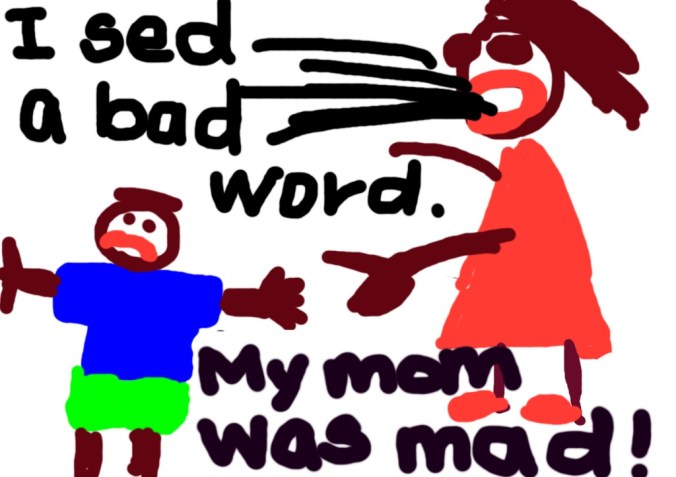
I recently read “I Ain’t Gonna Paint No More” by Karen Beaumont. If you haven’t read it, it’s hysterical.  The illustrations alone make me laugh.  In the story, the young man gets in trouble for painting all over the house and making a terrible mess.  After the story, we talked about things the students have done that have gotten them in trouble.  We went to the iPads and illustrated.  Some wrote directly on the illustration, others imported it into the Pages app and typed their story.  Boy, talk about true confession time! Here is my favorite.  It is a good way to end a Friday blog post.

I’d love for you to leave a comment, subscribe to my blog, and/or share this post with a friend.