On Safari

I hear and I forget. I see and I remember. I do and I understand-Confucius
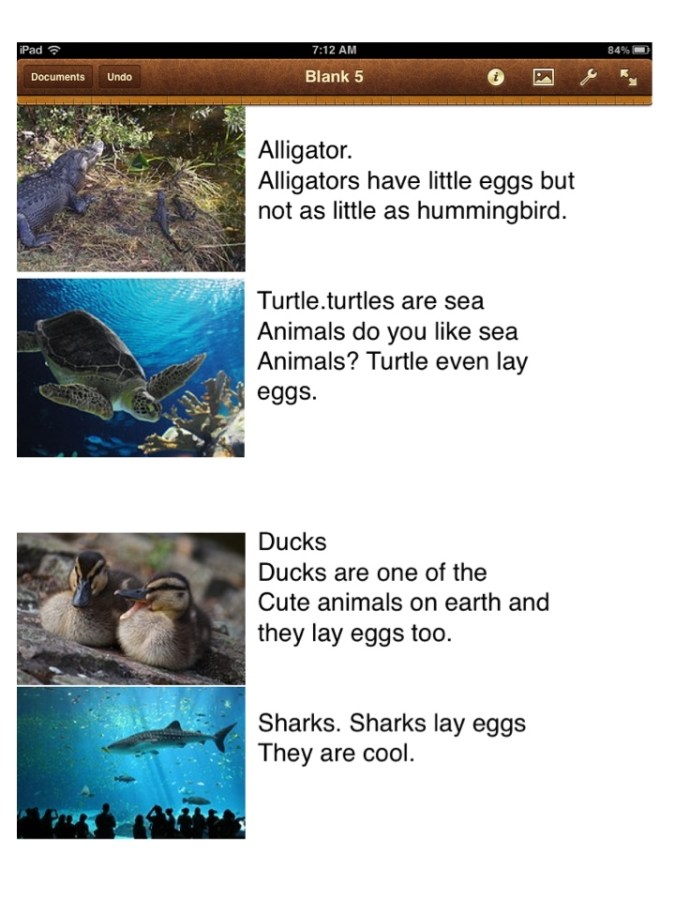
We did it.  We stepped out into the World. Wide. Web.  We have been talking about oviparous animals.  After a class read aloud of the book Chickens Aren’t the Only Ones, the children chose 4 animals that lay eggs. They Google searched the animals and found pictures of them.  Then they saved their images to the camera roll and imported them into their Pages App.  Once the images were imported in, the children wrote about them.  Finally, we shared our projects with each other.  This was our first time to go on Safari.  First, there is the issue of internet safety as children search the web. Second, there is the whole madness of 26 children learning how to search Google and choose an appropriate site and lastly, saving images to their camera photo roll.  This first time, we used Wikipedia for our animal images.
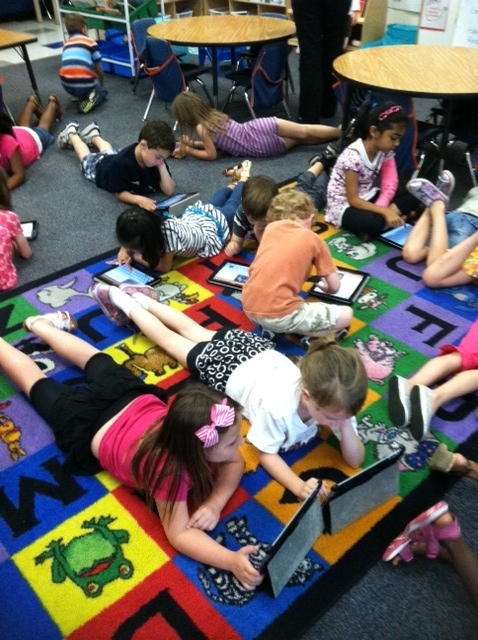
For instruction, I hooked my iPad to my Smart Board and was able to demonstrate step by step how to do things.  The children listened and followed directions beautifully.  As soon as they opened up their Wikipedia pages with images of the animals, the room was filled with Oooh’s and Ahhh’s.  A hush fell over the room and their eyes were huge with wonder. That beautiful Kodak moment was quickly replaced with tons of excited chatter and discussion.  By the second time I had demonstrated how to find the image and save it, the pros were done with me and moving at their own speed.  “Thanks, Mrs. Meeuwse, but we’ve GOT it.”  Teacher dismissed.

My original plan was to stretch this out over 2 days.  I thought on day 1 we would work on learning how to search the web and save our images. On day 2, we would import them in and type our facts.  The children had a different plan.  They were so engaged in this activity that when I suggested we wait and finish tomorrow, their faces fell and they said, “Why?” Why indeed, so we worked on.  They worked for an hour and a half before most all were finished and we shared.  After we shared, they asked, “Can we please do this again tomorrow?” “Tomorrow?” I asked.  “You want to learn tomorrow too?”

These crazy kids….

I’d love for you to leave a comment, subscribe to my blog, and/or share this post with a friend.

We’re Engaged!

Technology is just a tool. In terms of getting the kids working together and motivating them, the teacher is the most important. -Bill Gates

Engagement…a critical factor in learning and achievement. When kids are engaged, they are creating, thinking, analyzing, problem solving and collaborating. Recent visitors to our classroom from another part of our state came to see the iPads in action. They saw us during our morning literacy center time with students moving in and out of small groups. Students were involved in both partner and independent activities all around the classroom. Some activities involved iPads and some did not. The visitors comments were, “These children are SO engaged! They are managing their own learning and they know what they are doing. It all seems so seamless.”


Those comments are great! We work very hard to accomplish this; however, it doesn’t happen on its own. Engagement in any learning task depends on the carefully orchestrated classroom environment. You simply can’t place an iPad in a student’s hands and hope it all works out. What visitors see is a result of daily instruction, modeling, guided practice and gradual release of responsibility. My students know how to do many things, but more importantly, they know why they are doing them. Flexible grouping within the classroom and collaborative coaching are also necessary. My job is more important than ever! I can’t just “Skype in”.

High expectations and classroom rigor, along with incorporating appropriate iPad apps, are yielding dramatic increases in achievement in our at-risk students. Narrow curricula and rigid instructional practices hinder these particular students from excelling.

My kindergarten students will graduate from high school in 2024. Lack of student engagement is a major factor in student drop out. The use of iPads as a technology tool, personalizes student learning and addresses learning styles. They are visual, auditory, and tactile. With 52% of children under the age of 8 using iPods, iPads, smart phones and other digital media, it’s obvious what holds their attention.

We are working diligently to provide our students with a variety of experiences that are engaging and meaningful across all subject areas. The great thing about watching my students in action is that to them, it’s no big deal. When I tell them we have visitors coming to see all the great things they are doing, they just shrug it off as if to say, “Why all the fuss? Isn’t everyone using iPads?”

It’s a question worth considering.

I’d love for you to leave a comment, subscribe to my blog, and/or share this post with a friend.

Redefining Literacy with iPads

The illiterate of the 21st century will not be those who cannot read and write, but those who cannot learn, unlearn, and relearn.  ~Alvin Toffler

We are all such creatures of habit and we seldom like change…I tend to go to the same stores, eat the same food and sit in the same spot in school meetings and in church.  My students tend to sit in the same (unassigned) spot on the carpet and get upset when someone else is “in their spot”.  The girls tend to be far more vocal about it, but the boys are all “Dude…” and it usually is resolved without much argument. 

Change isn’t always bad.  In the last 23 years, I’ve gone from teaching with chalk and chalkboard, to whiteboard and dry erase markers, to a Smart Board,  and now I use both Smart Board and iPads. I’ve adjusted the way I teach by learning one way, unlearning and learning anew.  I can’t seem to function without my iPhone and iPads, both personal and professional.  (Yes, I have 2 of them.)  When I think about my kindergarten students, I marvel at all that they are able to do and to experience in this digital age.  Their language is peppered with “Tell your mom to text my mom so we can have a play date.”  “We downloaded a movie from Netflix and watched it on the laptop.” “I played Angry Birds on my mom’s phone when we went out to eat.” “Why do you need a map when you can look at the GPS?”

When asked to define literacy, our first thoughts tend to go toward the obvious- reading and writing.  It seems more accurate to define literacy today. Librarian Valerie Strauss defines literacy today as Transliteracy.  She says, ” Literacy has evolved, to not be defined or confined by container or format. It’s not just reading words on a page. It might be decoding graphic novels, it might be decoding video. It will be literacy in forms we haven’t even dreamed yet. We should encourage kids now to get their literary riches in formats that appeal to them and that they are comfortable with, whatever it may be. That is the future. The literacy of the future is finding meaning in many forms.”

Ipads serve a very real purpose in today’s “transliterate” classrooms.  I find they are easy to incorporate in all areas of content; and my students, as young as they are, lead the way.  I’m glad I’m along for the ride.

I’d love for you to leave a comment, subscribe to my blog, and/or share this post with a friend.

Problem Solving and Math Apps

Before beginning a hunt, it is wise to ask someone what you are looking for before you begin looking for it.-Winnie the Pooh

Problem solving is a critical skill and a large part of the foundation for early learning.   Opportunities for problem solving exist in everyday life.  By exploring their environment, manipulating objects, thinking critically, and building on existing learning, students can strengthen problem-solving  skills.

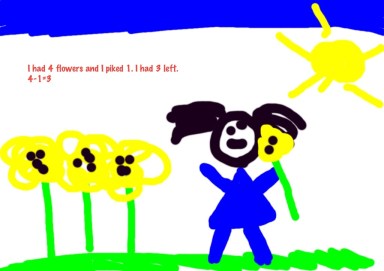
We have been using our iPads to create story problems in our Whiteboard App.  Students draw the story problem then type the number sentence to represent the picture.  We have even had a story problem exchange.  Students create the picture to represent either an addition or subtraction problem.  Then they pass their iPad to a friend who looks at the picture and figures out the appropriate number sentence.

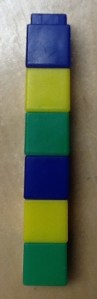
Another activity my students have enjoyed is taking objects in our classroom such as unifix cubes or pattern blocks and creating a pattern.  They use their camera on their iPad to take a photograph and trade iPads with another student.  That student identifies the pattern and re-creates the pattern using Pop Beads app.

Using these manipulatives, students can make visual representations and I can model for students.  The iPads create another opportunity for practice and integration.  It can serve as a calculator, a notepad, an information resource, and flashcards.  It keeps score, tracks progress, and many apps monitor and adjust content.  iPads allow me to also integrate content.  The word problem in the above picture was created by a student after we studied seeds and plants.  She typed a science journal entry in Pages and then created her story problem.  The iPad allows for seamless integration of subjects that makes sense to students and increases their understanding of new concepts.

Other apps my students enjoy using in math are Math Bingo, Park Math, Monkey Math, and Flash to Pass.

By providing sustained opportunities for students to solve problems in a variety of contexts, they begin taking responsibility for their own learning.

I’d love for you to leave a comment, subscribe to my blog, and/or share this post with a friend.

Write On!

Fill your paper with the breathings of your heart.  ~William Wordsworth

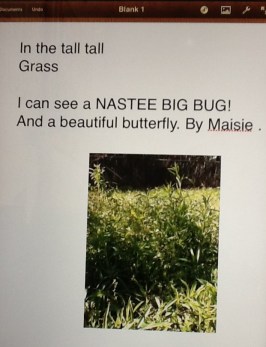
One way we’ve been making connections with our reading is to use our Pages App as a Reading Response journal.  Students write about what they are reading.  It’s a way to share thoughts, feelings, and questions.  The story we read was Denise Fleming’s In the Tall, Tall, Grass. Students wrote their thoughts about the story.  Some shared connections they made with the story.  Reading Response journals enable the children to think more about the story.  My students often have difficulty thinking beyond the text.  If asked “Why do you think” kinds of questions, they are reluctant to answer because they are afraid they will get it wrong.  At 5 years old, they are already conditioned to give the “right” answer.  I want them to think beyond what is written in the story and explore the possible feelings and/or thoughts of the characters.  This opens discussions up for making inferences and predictions.  I model this by stopping during shared reading and thinking aloud, discussing things I wonder and make predictions about what is about to happen next in the story.

Another good way to use the Pages App is to have the students do writing extensions beyond the text after reading. For this activity, we took our iPads outside and took photographs of the tall grass near our room.

The students wrote what they might see (or have seen) in the tall, tall grass.  They imported their photo into Pages and shared with the group their innovations on the story.

Using Pages is a great app for journal writing. Whether Reading Response or Science, it’s a great way for students to quickly get their thoughts down.  Having the camera option is a terrific means of incorporating their observations.  These activities had my students completely engaged and asking when they could write some more.  Isn’t that what it’s all about?

I’d love for you to leave a comment, subscribe to my blog, and/or share this post with a friend.

Y-E-L-L Everybody Spell!

“It’s a poor mind that can only think of one way to spell a word.-Andrew Jackson

Um, did I mention these children are 5 years old?  Clearly our little ones are heavily influenced by our text-rich world.

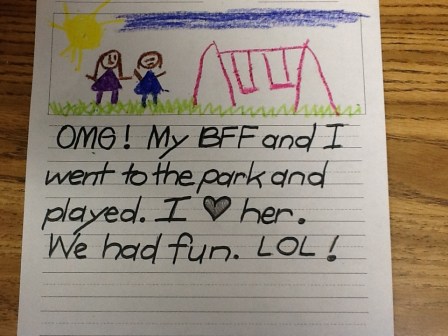
In kindergarten, we place emphasis on invented spelling. Invented spelling is the practice of young children using their best judgement when writing words.  This opens the children to using more of a variety of words than if they only write the words they know how to spell correctly.  Students write what they hear.  When students use invented spelling, they seem to develop word recognition and phonics skills sooner.  The more they write, the more confidence they have in their writing.  The process of getting it out of their head and onto the paper is the key rather than have them get bogged down in spelling words correctly.  My students are easily able to write several sentences on a given topic on their own.  We have environmental print in the room on the anchor charts, plus they use invented spelling.

Using the iPads, I am able to give the students opportunities to practice spelling high frequency words and word family words.  We use the app Spelling 1-2.  This allows students to work on their own list of words.  In the beginning of the year, I put their words in the app, but later they can put their own words in themselves.  They practice all week on their given list of words on the app and they are assessed weekly.  This ability to differentiate instruction allows my higher students to move on to more difficult words and my struggling students to practice what they need.  At one point this year, I had 4 different lists going on the iPads.  Now I’m down to 2.  With a class of 26 students, I am able to meet the needs of each of my students where they are. We  use a few other spelling apps for fun.  Two of the apps we like are Montessori Crosswords and Word Wizard.

As we allow students to express themselves in a safe, encouragement environment, we see the possibilities and their creativity flourish.

I’d love for you to leave a comment, subscribe to my blog, and/or share this post with a friend.

The Play’s the Thing!

Without this playing with fantasy, no creative work has ever yet come to birth. The debt we owe to the play of the imagination is incalculable. -Carl Jung

Play is an essential part of Early Childhood Education.  It stimulates cognitive, motor, and social skills.  Children are playful by nature and interact with their environment through play.  It reduces stress and promotes well-being.  Even now, in this time of high expectations and educational rigor, we still play.  Our class has learning centers for literacy, math, science, art, blocks, reading, Legos, housekeeping and iPads.  The children spend time in each of the centers every day. The structure of our day lends itself to creativity and self-directed learning; yet, it is still structured and the learning environment is carefully planned.  If you ask the children what they did all day, they will say, “I played.”
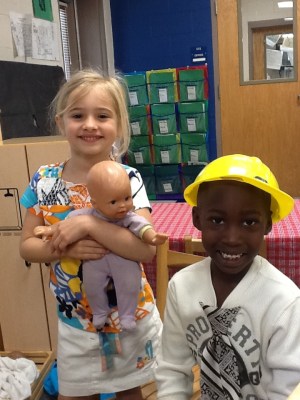
In the mornings, we have Reading Workshop, guided reading and literacy center rotations.  After lunch and recess, we have a whole group time where we have our shared reading, our read aloud and our word-work.  We also have discussion on whatever thematic unit we are on before going into Writing Workshop and more center rotations. Throughout the day, students are rotating in and out of small group instruction and center time.  The iPads serve as a tool in our classroom to facilitate  differentiation of instruction.  Even as Parker Jane and Dontay played in the housekeeping center (see picture above), they decided they needed to make a grocery list on their iPads.  They collaborated together to create a list in the Notes app.  I didn’t have to suggest that…they came up with the idea and moved to a table with an iPad to create a list of about 8 or so items, then they pretended to go shopping. One read the grocery list, while the other shopped.  As they are creating their own learning, they are problem solving, analyzing and synthesizing new information.
Play is all about exploring possibilities. In our world today,  exploring possibilities is a valuable skill.
Our classroom is a busy hub all day as students collaborate, learn, share, explore, inquire, and yes…play.

Making a grocery list for housekeeping center

I’d love for you to leave a comment, subscribe to my blog, and/or share this post with a friend.

Gettin’ Buggy With It…Using iPads for Literacy and Science

“Do not limit children to your own learning, for they were born in another time.”  Chinese Proverb

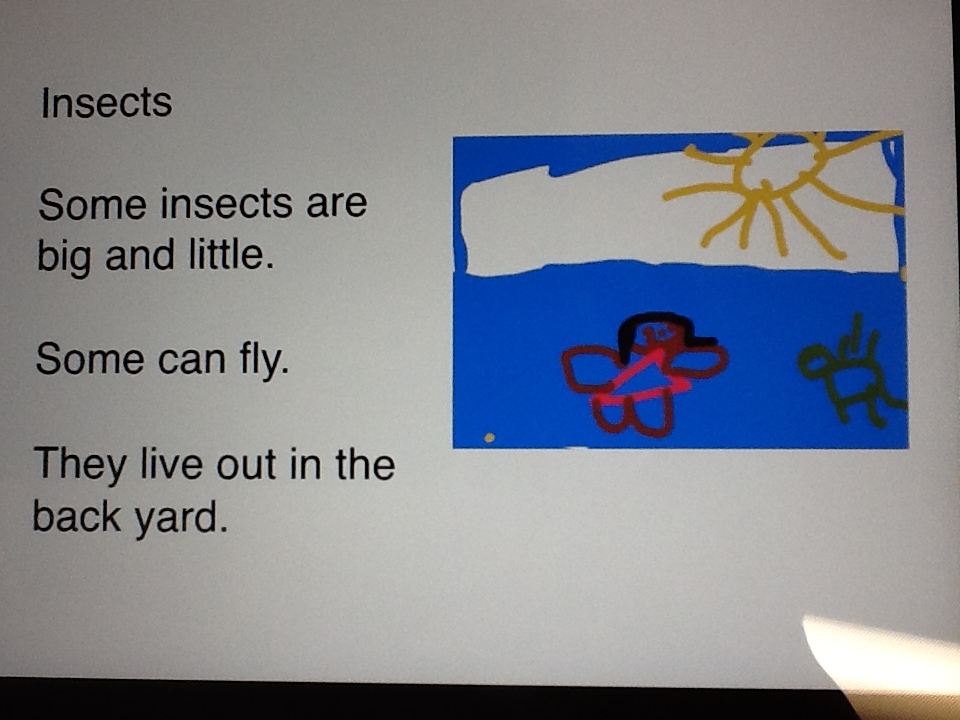
One of the most exciting aspects of using the iPad is integrating it with the content I am covering in class.  We’ve been discussing insects, and what 5 year old isn’t fascinated by bugs?  Today, my students used the Pages app as a science journal to write about insects and then created illustrations in their Whiteboard app.  Afterward, they imported their picture into the Pages document and re-sized it to fit on the page.  Throughout the process, they were buzzing (no pun intended) with each other about their insect facts, helping one another with importing their illustrations, and proudly sharing their masterpieces.  In addition, as children shared their work, they were reading and developing fluency.

Many years ago, when I was in kindergarten, I was given a fat, black, eraser-less pencil and primary-lined paper to write on. I am left handed and as I wrote, my hand smeared my words.  Unable to erase, I would get frustrated and not want to write.  Even in the early 80’s when I was in college, I had no computers available or even typewriters to type my papers.  As our students move into the digital future, they will learn by doing.  I am preparing them for jobs that don’t even exist yet!  It is crucial that content be engaging and relevant and that the rigor in our classrooms promote those higher order thinking skills.  If you break down this iPad exercise into steps, this is what they had to do:

1.  Open the Pages app and change the font size.

2. Type the title and their content. (which is no small feat since they don’t have keyboarding skills, plus they are sounding out their words at the same time)

3.  Open Whiteboard app, create illustration and save it

4.  Go back to Pages and import illustration and re-size.

5.  Read and share

On the revised Blooms Taxonomy, these students were creating, evaluating, analyzing and applying.

This isn’t old school kindergarten.  We are cutting-edge, 21st century learners!

Listen to Gracie read her insect story from her iPad…


I’d love for you to leave a comment, subscribe to my blog, and/or share this post with a friend.

Closing the Achievement Gap: Data and Test Scores

Where’s the Beef?  Show me the money! What’s the bottom line?

In today’s results-oriented, data-driven mentality in education, we all fall under the large
accountability umbrella of test scores.  Certainly, there are skeptics who question putting iPads in the hands of young children.  It is asked, “How can we justify the cost of this technology when school budgets and programs are being cut and teachers are being furloughed?”  I too, asked those questions at the beginning of this pilot.  After all, my pay has been decreased from furloughs and no step-increases for experience or cost of living.  My answers came directly from the very people for whom I work…my students.

Let me say that I teach children, not tests.  I want my students to find a love for learning that sustains them for a lifetime.  In a previous post, I described what kind of reader I am.  I want my students to be filled with wonder and inquiry and to find joy in reading and learning.  A commentary written in USA Today states that the goal of education should be to prepare students to be competent and original in their thinking and that focusing on test scores hurts innovation.  When we start focusing on scores, we often stop focusing on innovative teaching methods and divergent thinking. Don’t get me wrong…teaching involves assessment and assessment drives instruction.  The problem comes when we stay focused on the one-dimensional scores and not look at the whole child.  William Arthur Ward states “Wise are those who learn that the bottom line doesn’t always have to be their top priority” Sermon over.

All of that being said, I do understand that the purchase of the iPads was intended to close the achievement gap and raise scores.  So far, they’ve delivered on that.  I’ve been using the iPads for 13 months.  Last school year, we began implementation in late January.  My class results are here.  ipad-data pdf  We were thrilled!  Systematic teaching in Reading and Writing Workshop, along with differentiated instruction with the iPads allowed all 30 of my students to end the school year reading on or above grade level.  This year, with 12 weeks of school remaining, 92% of my students read on a first grade level or higher and the remaining 8% are on grade level. Interesting to note, the 8% are students who came to my class after Christmas from other schools.  They have moved from being non-readers to reading on-grade level in 3 months.

While I don’t solely focus on test scores, I can’t deny the results I am seeing.  These are results that can’t be overlooked.  If good teaching, and iPads as educational tools, result in higher achievement, then how can we argue that our children aren’t worth the investment?

The Force is With Us…

In Star Wars: Episode I — The Phantom Menace Darth Maul said, “At last we shall reveal ourselves to the Jedi. At last we shall have revenge.” Well, that didn’t quite work out, did it? At least not then, and certainly not because of the tattooed Sith Lord. Sure, Maul killed the preachy Qui-Gon Jinn, but he in turn got cut in half by Obi-Wan Kenobi.

Huh?  I’m clearly out of my element.  I introduced a new book in our reading center today. It is an encyclopedia of Lego Star Wars characters.  Saying it was a huge hit is an understatement.  The above discussion, or something like it, was taking place today between Hagan and Caleb.  They are my Star Wars experts.  The excitement over this new book was not unexpected.  Interest inventories taken on my students clearly showed the need for this new addition.  However, what happened next was unexpected. In the midst of all of the Star Wars techno-babble, the boys decided it would be great to go to the iPad and write about it.  They planned out what they wanted to each write and how they would illustrate it. The discussion  was amazing.  Their engagement was priceless.

I am passionate about my students’ writing.  We have several author studies throughout the year and I use mentor texts to inspire their writing. It is essential in teaching creative writing to provide opportunities  to link writing topics to who the children are familiar with and to what excites them.  Conferring with the students, having them look at their own writing and sharing their writing helps them make connections with good reading and writing skills.  The use of iPads, in conjunction with systematic teaching in Reading and Writing Workshop,  is producing the most advanced reading and writing that I’ve seen in the 23 years I’ve taught. The data is compelling.

Hagan and Caleb-Star Wars aficionados

Whether the students are writing on iPads, blogging, creating eBooks, or writing with pencil on paper, they are immersed in rich language all day long.

So, whether you side with Darth Maul or Obi-Wan Kenobi, I believe “The Force” is strong in kindergarten!

I’d love for you to leave a comment, subscribe and/or share this post with a friend.