Learning in the 21st Century

Multimedia brought the world into the classroom, smart technologies will take the classroom into the world.” -Steve Wheeler

My 90 year old father-in-law always seemed to be fascinated by the fact that we could call him from just about anywhere with a cell phone.  This technology was as foreign to him as a phone tethered by a coiled phone cord on the wall will be to my kindergarten students.  I mean, aren’t we all just a little surprised when we meet someone who doesn’t have cable tv, or not just a smartphone, but not even a cell phone these days? The technology treadmill just seems to keep on increasing speed and incline making it difficult for some  to keep up.

Our students, even the youngest ones, get it.  They understand the value of connectivity, media, and mobile learning.  Being restricted to 4 desktop computers in a classroom of 25-30 students is archaic at best. Less than 0.01% of the information we generate today is ever printed on paper. Information technology is becoming more and more personal and “pocketed”.   The core issue is that teachers need to be at the center of their own learning if they are to change their life-long habits and beliefs regarding the use of technology.  Perhaps we’ve looked at this backward.  Perhaps instead of trying to integrate technology, we need to redefine literacy and integrate that. Information literate people are those who have learned how to learn.  It is difficult to teach students and prepare them for an uncertain future.  Our best approach is to teach them how to teach themselves. Learners are creating their own learning spaces, blending face-to-face with virtual, and formal with social.

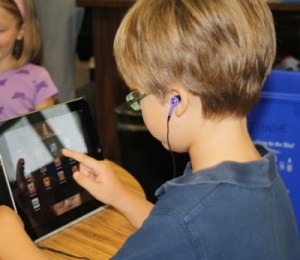
Do you remember your 3rd grade teacher (or any grade for that matter?)  Mine had been teaching for 30 years when I was in her class.  She taught the same thing in the same way on the same day of her 30 plus year career.  Bless her heart.  Today, no teacher should believe he/she can teach the same thing the same way.  iPads have been transformative to my teaching.  Not only is the learning mobile and individualized, it is engaging and collaborative.  Our school district is continuing to explore and expand the use of iPads in elementary, middle and high school classrooms.  A recent article in our local newspaper outlines where we are as a district at this point.   As a district, we are striving to put the learning in the students’ hands.  As educators, we have to realize that mobile learning isn’t about delivering content to mobile devices, but instead is about learning how to operate successfully in and across new and ever changing contexts.

I am more energized about my teaching now, more than ever before.  iPads have been a game changer.  I can’t imagine ever teaching without them and I’m excited about finding new ways to incorporate them.  I too, am learning on the go!

I’d love for you to leave a comment, subscribe to my blog, and/or share this post with a friend.

A Balancing Act

Getting information off the Internet is like taking a drink from a fire hydrant.- Mitchell Kapor

I’ve just returned from 2 weeks of vacation.  While away, I experienced 2 extremes of technology.  Part of my vacation was on beautiful Lake Champlain in Vermont.  Verdant pastures, mountains and cooler temperatures certainly made it a welcome change from the 100 plus degrees and oppressive humidity of Charleston.  With the beauty of this place, came absolutely no Verizon coverage.  No phone and very spotty wireless internet made it sometimes frustrating for my embarrassing need to connect.  After the first day of trying, I just turned my iPhone off and put it away.  The Vermonters like it that way I’m told…

In contrast, we spent a long layover in New York’s La Guardia airport.  Delta has recently installed 2,500 Ipads in the very small D terminal. Booths and bars were set up all over the terminal replacing the regular seats at the airline gates.  Ipads were everywhere.  Free to use.  Well, free limited use that is.  Certain apps were available for free. A convenient credit card swipe device was attached to each iPad if you wanted to go beyond the free apps.  I sat and watched as kids ran immediately to the devices and navigated their way easily to the games apps.  The adults were a little more apprehensive. A few even admonishing their children to “be careful” as they touched the iPads.  Many of the kids had never used one before based on the conversations going on around me.  The kids were engaged and busy and quiet. That was a welcome change from most airport experiences I’ve had lately.

So what’s the take away here?  I think it’s a good reminder of balance.  Being “off the grid” in Vermont was a little unsettling for me for the first 24 hours but it forced me to do other things.  In some ways, it was very freeing.  I couldn’t check email or voicemail or Facebook or text messages so I didn’t think about it.  The airport was as far removed from the quiet, pastoral lake setting as east is from west.  Everyone was connecting in some way with electronic devices, adults and kids alike.  Debate continues in my city about the need and value of iPads in the classroom.  Most are concerned about the financial commitment but many are concerned that students won’t experience hands on learning and interactivity with others if iPads are used.  Balance is the answer.  I’ve stated before that my kindergarten students still play in centers with blocks, paint, puzzles, games and even dress up.  We also use iPads as a tool for enhancing our learning in all subjects.  Any technology has the potential to be used inappropriately by teachers and by students.  It requires careful planning and teacher facilitation to be successful.

As I am wallowing in summer vacation and seldom know what day it is, my recent trip was a good reminder that we all need to unplug, go off the grid, and do other things from time to time.  School starts back for me in 5 weeks.  I think I will be like Scarlett O’Hara and “think about that tomorrow.”

How do you create balance in your fast-paced life?

I’d love for you to leave a comment, subscribe to my blog, and/or share this post with a friend.

Focus on Vocabulary: Tiers 1,2, and 3

One forgets words as one forgets names. One’s vocabulary needs constant fertilizing or it will die.- Evelyn Waugh

Is it possible to overstate the value of words?  Our ability to function in today’s complex world is determined by our language skills. We use expressive vocabularies to speak, receptive vocabularies to listen and comprehend, and literate vocabularies to read and write.   A large vocabulary is  reflective of high levels of reading achievement. Yet, often, vocabulary instruction is over-looked in schools today as other skills get pushed to the forefront.

We used the iPads last year for phonics practice as well as vocabulary acquisition.  Our Tier 1 words (sight words), we practiced in several apps, most notably Spelling 1-2 and Spelling Bee.  We worked on Tier 2 words (essential for understanding text, non-redundant words) in Montessori Crosswords and our Magnet board apps.  Tier 3 words (infrequently used, subject specific words) can also be practiced with these apps.  These apps allow for many opportunities to talk about and work with words.

Young students learn to communicate through listening and speaking. As students learn to read, they develop fluency and automaticity through rapidly using decoding strategies.  A large amount of attention in the early grades is placed on high frequency words.  These are very important for emerging readers.  However, it can’t stop there.  We must increase comprehension through the use of Tier 2 and 3 words.  Research is showing that in 4,469 minutes of reading instruction, only 19 of those minutes went toward vocabulary instruction and acquisition.

The most recently released study of international reading achievement provides some strong evidence that the weakness in U.S. student performance is not the result of decoding problems or inability to comprehend narrative texts. Instead, it seems to be due to weakness in ability to comprehend.  informational texts (Progress in International Reading Literacy Study, 2003).  80% of text that adults read is informational.

Through the iBooks Author software, I was able to create a few high-interest non-fiction texts that were on my students individual reading levels last year.  By having these texts on their iPads, they have them handy whenever they want to read.  I have also downloaded the I Like Books app.  It is a collection of 30 (free) non-fiction books.

Through the use of these reading apps and the apps mentioned above for practicing vocabulary, I am able to increase the rigor in vocabulary instruction.

I’d love for you to leave a comment, subscribe to my blog, and/or share this post with a friend.

High Progress Classrooms, The Common Core and iPads

Leadership and learning are indispensable to each other.- John F. Kennedy

I’ve recently completed training on High-Progress Literacy Classrooms and Common Core State Standards for Language Arts.  One of the guiding premises behind the Common Core State Standards (CCSS) is the standards are designed to be robust and relevant to the real world, reflecting the knowledge and skills that our young people need for success in college and careers. The shifts from the old state standards to the new CCSS are student-focused.

Students will do more than just read texts for basic comprehension.  They will be expected to pull from multiple sources to synthesize diverse texts and ideas, consider multiple points of view and read across texts. The ultimate goal of each standard is that all students will demonstrate key skills articulated in the CCSS on their own.  The expectations spiral across grade levels to help students reach this goal.

During this training, I read something written by Donald Graves called The Cha-Cha-Cha Curriculum.  He states that it is a sign of the times that silent, sustained reading lasts only twelve minutes and that we race our children through everything ever recommended.  Time is our scarcest resource and to teach well, we do not need more techniques, activities or strategies.

Using the iPads the last 2 years really helped me hone in on the essentials in teaching reading and writing.  Students are able to construct their own learning. They are able to research, read, write, and create.  Much of our curricula still includes things we no longer need or no longer feel strongly about.  By cleaning out our “curricular closets” we are more easily able to focus on those essentials.

The CCSS will definitely provide more rigor in our instruction.  These standards are designed to help ready our students for post-secondary education and the workforce.  Our students now will become our future leaders.  I’m excited about the possibilities of using the iPads in conjunction with these standards in the fall when we return to school.

I’d love for you to leave a comment, subscribe to my blog, and/or share this post with a friend.

Living the iLife: iPhoto, iMovie and Garage Band

Creativity is a natural extension of our enthusiasm.-Earl Nightingale

One of the great things about teaching young children is their ability to entertain themselves with just about anything.  Given a stick, it becomes a bat, a spear, a magic wand…their imagination has no limits.  My students role play, create, draw, paint, and pretend.  When is the last time you did any of those things?  Grown-ups don’t do those things right?  That’s for kids.  When did we lose our ability to create?

School systems are inherently driven by standardization.  Students are jumping through pre-designed hoops and creativity seems to be a side dish in the entree-heavy school system.  It seems to be overlooked that creativity can be a great intrinsic motivator. Creativity, if not nurtured, will take a nose-dive before a student leaves elementary school.

A great tool for the iPads is a suite of apps that help incorporate creativity into any content.  The iLife suite includes iPhoto, iMovie, and GarageBand.  iPhoto allows you to browse, edit, and share your favorite pictures.  iPhoto can also create slide shows and books.  iMovie allows you to turn video into movie trailers, tv news segments, and more.  With travel maps in your video travelogues, everyone who watches comes along on the adventure.  The drag and drop feature makes it easy to use.  Garage Band allows you to “get your groove on”.  You can use and edit existing music loops, or create your own using a variety of instruments.  Even if you have never played any of these instruments before, you are able to create a masterpiece.  Voice recordings are also available which you can then add to iMovie.

The iLife Suite gives students the power to create. Teachers often identify their main goals as helping children build cognitive and social skills. But the great engine that drives innovation and invention in society comes from people whose flame of creativity was kept alive in childhood.

Giving students freedom within a structure gives them a clear goal but also alternatives on how to get there.  By incorporating creative tools into the curriculum, students can explore the depths of their inner artist.

Check out the iLife Suite and see the possibilities.  Let freedom ring!

I’d love for you to leave a comment, subscribe to my blog, and/or share this post with a friend.

iPads and Field Trips

The World is a book, and those who do not travel read only a page. -St. Augustine

Summer is a great time for travel.  Last summer, I was able to travel to Europe for the first time.  We visited the Netherlands, Luxembourg and Belgium.  It was truly the trip of a lifetime and I would love to go back!  Travel opens our minds to different cultures, experiences and people…and amazing food!  This trip allowed me to see things and experience things I would never be able to experience in my little corner of the world.  In fact, it made me wish I had paid more attention in my World History class in college.  Walking through the poppy fields of Flanders takes you straight to 1918 and World War 1.  Standing on the battle site of Waterloo puts you in the bloody final campaign of Napoleon in 1815.  I soaked up the history and beauty of these historic gems.

Our students need to experience the larger world beyond their own little corners as well. Class field trips enable educators to broaden students and enhance their educational experiences.  With iPads in the classroom we can re-think how field trips are done.

Taking iPads on a field trip would allow students to capture what they are seeing, reflect on what they are learning, and create meaningful artifacts of the experience.  The information collected on the trip could be put into an iMovie or Keynote to share with others and for assessment.  Using the information gained on the trip and transforming it into an iMovie uses the higher order thinking skills we desire for our students.  To protect the iPads, students could place them in their school book bags.  That would allow the students to be hands-free if needed, but have the iPads handy at the same time.  Having a class set of back packs just for field trips would be the ideal.  I saw one on Amazon.com for $19.99. It is made for tablets and is lightweight enough for younger children. Now I just need a wealthy benefactor to get them for me!

What about the trips that are too far away or are too expensive?  Because of bus costs, increased gas prices and the cost of some venues increasing, we have had to cut the number of trips we take during the year.  What if you want to visit a place that is in another country?  The iPad can take you there via virtual field trips.  On a virtual field trip, you and your students can go just about anywhere on Earth — or even into the solar system.  There are many websites that have virtual field trips already set up, such as this one to the Great Wall of China, or you can create your own.

Field trips can be great educational additions to any curriculum.  By incorporating iPads, our students have endless possibilities to explore their world and beyond!

I’d love for you to leave a comment, subscribe to my blog, and/or share this post with a friend.

Summer Fun and Draw Something

A vacation is having nothing to do and all day to do it in.  –Robert Orben

I live 10 minutes from this beach.  It serves as both an inspiration and a distraction depending on your frame of mind.  After a long school year, it is a soothing medication to frayed nerves.  The wind and waves are hypnotic.  On this day, soaking up the warm sun, I find I must confess something…

I am addicted to the Draw Something app on my iPad.

Draw Something is a free social drawing game you play with others.  You can find friends through email or Facebook.  Once you create a game with someone, you are given 3 words of varying difficulty to choose from.  You choose the word and draw.  When finished, it goes to the other person who watches your drawing being created on their screen.  They are given a tray of letters at the bottom they must choose from and re-arrange to guess the word.  Once they guess, it is their turn to draw and you must guess.  Coins are earned for the varying difficulty of the pictures drawn and they may be exchanged for additional colors. It is similar to the game Pictionary.  I find that using a stylus is much easier for drawing than using my finger.  It is fun and I think I mentioned…addictive. 

While this app isn’t appropriate for my students, the concept is appropriate. Initially, I could introduce the game on my iPad with the Whiteboard app.  I could draw something they would be familiar with and have a few letters at the bottom for them to unscramble to guess the word.  Showing this on my Smart Board would allow all to see and participate.  Once they have the concept of the game, they could then partner play on their own.  This would build spelling skills, vocabulary and fine motor skills.

Of course, I will spend this summer in *ahem* Research and Development to perfect any “kinks” to make it easier for my students…after all, it is about them right? Um, gotta run…it’s my turn and I need to figure out how to draw Lady Gaga.

I’d love for you to leave a comment, subscribe to my blog, and/or share this post with a friend.
Mirror, Mirror, Reflecting on the School Year

I had chosen to use my work as a reflection of my values.
-Sidney Poitier

School is finally out! I have a 10 week summer stretching long before me.  Since this isn’t my first go-round with summer vacation, I know how quickly it vanishes.  I used to make a long list of things I wanted to accomplish both at home and for school.  I would find myself frustrated at the end of summer having accomplished less than half of that list.  Instead, I’ve learned to enjoy the time of no deadlines, no paperwork, no alarm clock and no schedule.  I’ve learned…to reflect.

Teaching, for me, is a calling.  It is rewarding and draining all at the same time.  By the end of the school year, I need to recharge and reconnect with me. Reflection of the year happens slowly over the summer.  At first, I just need to decompress.  I also congratulate myself on the things that went well.  We all need to do that.  Later, I begin to think of things that I could have done differently or that I want to change.  Sometimes, it is just a matter of tweaking something and other times it is more drastic.  Reflection helps us to stand back, out of the fray, and look at things a bit more objectively.

Using iPads the last year and a half has been a major source of my change.  It has definitely been a “learn-as-you-go” operation.  So much of what we have done has gone well and so it is easy to rest on that.  Test scores are up, student achievement is up and parent approval is high.  Those are all things to celebrate, especially in such a short amount of time since implementation.  Still, there is always room for improvement.

I’ve been using iBooks Author to write some leveled texts for my students.  I’ve also written a few books for content areas such as Social Studies, Science and Math.  I wrote many of those toward the end of this year and was unable to utilize them much with my class.  I want to write more books this summer and have them ready to go for student iPads in the fall.  I also want to do more personalization of the books with the students to increase their interest.  My goal is to write a short “All About” book for each student in the fall.

In addition to the iBooks Author, I want to incorporate iMovie and create short videos for students and parents.  I just purchased Roxio Toast 11 so I can burn DVD’s from iMovie.  The new MacBook Pro doesn’t have iDVD. So many skills and some good content can be incorporated when students make their own iMovie.  This also puts their engagement through the roof.

Wow…I’ve been out of school 3 days and I have quite a list.  I’m sure I will work on this and tweak it over the coming weeks.  I can’t wait to see how it will all turn out!

How does reflection work for  you?

I’d love for you to leave a comment, subscribe to my blog, and/or share this post with a friend.

iPads in the Classroom: A Parent’s Perspective

School is officially out for summer. Today’s post was written by Angie Mizzell. Her son Dillon was in my class this year.

“Mom, how many trees are in the world?” my son asked a few weeks ago, as we were driving to school down a two-lane, tree-lined road.

“That’s a really good question. I don’t know. Billions? Trillions? A lot.” And then I remembered a blog post Kristi had written. “I wonder if there’s a way to find out?”

He responded quickly, as if he’d come to the conclusion on his own. “I could type on my iPad, ‘How many trees are there.'”

When my son started school last August, he was still learning letter sounds. Today, as an official kindergarten grad, he’s reading on a first grade level and doing Google searches to find out how many trees exist in the world. (Turns out I’m a good guesser.)

Did the iPad contribute to that? That’s a question for people who collect data. I’m a mom, and I tend to operate under this philosophy: Seeing is believing. And what I’ve seen is a teacher who uses iPads to meet her students where they are and take them as far as they can go.

I visited the classroom earlier in the year, and it felt familiar to me—a mix of what I recall about kindergarten and first grade combined: Students writing on primary ruled paper, breaking up into smaller, focused reading groups and playing in centers (think blocks and housekeeping). And of course, the children were oozing with cuteness.

I watched a child at the SMART Board, building words by dragging letters from the bottom of the screen. I was intrigued by how engaged my son appeared while working on his iPad.

It’s the natural evolution of things. Today, when my child walks around with a notebook and a pencil (his journal, he says) recording thoughts, I realize the “old” and the “new” can coexist.

My son represents the future, and I’m encouraged by what I see.

Change and Relevance

Make sure that our methodology is not simply packaging old wine in new bottles. Teaching today requires a whole new vineyard.-Robert Meehan

Are you someone who embraces change?  Perhaps it depends on the circumstances.  Regardless of the situation, change happens. Sometimes it happens slowly…giving us time to adapt and accept.  Sometimes, it happens in a split second, leaving us to wonder what in the world just happened.

Recently I was discussing maps with my students.  It is a state standard in Social Studies.  We were doing a pirate themed unit and I couldn’t think of a better way to talk about maps than in the context of digging up a buried treasure. During the discussion and the showing of this awesome pirate treasure map (courtesy of Pirates of the Caribbean at Disney World), I noticed my students seemed a bit puzzled, maybe even skeptical.  I stopped and asked what was the problem.  One of them said, “Why didn’t the pirate just use a GPS?”  Someone else said, ” The Maps App on my iPad would show them where to go too.”  Hmmm….are maps (the old school kind that I can never fold correctly) becoming obsolete

Technology makes our lives easier and faster in many ways. Technological advancements in medicine and business have changed the world.  So why are so many reluctant to change the way we educate children?  Money, or lack of it, is always one response.  What if you went to work and found your computers and telephones were suddenly gone.  Sorry…we just can’t afford those fancy things.  How would you do business? Could you still get the work accomplished? Perhaps…with paper and pencil, snail mail and couriers. Technology makes our work more efficient.  It also makes my teaching more efficient.  It makes their learning more engaging and accessible.

As we seek to educate children and prepare them for a successful life as an adult, we cannot pretend that technology doesn’t matter.  One at risk high school in my district that uses iPads, recovered over 700 days of instruction in just the second semester this school year that were previously lost due to discipline issues.

Today, I locked up my class iPads for the summer.  I wheeled them down the hall to be stored for the summer.  We have only 2 half days of school remaining.  I’m already making a list of things I want to do next year.  I want to do more with iMovie and iBooks Author.  Part of staying relevant means growing a new vineyard.  My teaching practices have changed as my students needs change.  Next year will bring new challenges.  I will hopefully be ready….after a nice 10 week summer vacation, of course.

I’d love for you to leave a comment, subscribe to my blog, and/or share this post with a friend.