Personalized Learning: Spelling

“Don’t they teach you how to spell these days?” “No, they teach us how to use spell check.” -Jodi Picoult

I have to confess…I am one of those people who never had trouble with spelling.  It came easily for me and my nickname in middle school was “dictionary”.  I hated that then, but having the ability to spell has always served me well.  In this “spell check” world, it seems as if spelling may not matter.

Fortunately, my 5 year olds have some of the same desire for spelling correctly as I.  They don’t like to get things wrong and they get concerned when they are typing in Pages and they get the red, squiggly underline indicating they have spelled incorrectly.

Since we are focusing on personalized learning, I have different spelling lists for different groups in the class.  We are working on word family words mostly at this point.  Spell Test is a free (for now) app that is very basic and simple but provides me a helping hand in managing different spelling lists and tests.

How does Spelling Test work
1. Create a Spelling Test
2. Choose a Name for Your Test.
3. Start by adding Words to your test.
4. Record your own Pronunciations in an easy to use format.
5. Now Take a Test.
6. Listen to the Pronunciation and Spell the Word in the Box correctly.
7. Instant Feedback on how you did, Did you get that right or wrong
8. Complete the Test to see a Summary of Words.
9. Each time you take a test, you will know which words you got right and which you got wrong
10. Track improvements as you take the test multiple times.

The kids like using their own voice to record the words.  I can also record words if pronunciation is an issue.  The app doesn’t show them the words during the test.

This is an easy way to personalize spelling for each child.  I’m not ready to give up to spell check completely.  I still see value in teaching words, word roots, and phonics.  Practicing with an app makes it fun for the kids, but it also allows me to individualize each list if necessary. Because it is an app that is available for iPhone and iPad, parents can also have students use it at home to practice.

I’d love for you to leave a comment, subscribe to my blog, and/or share this post with a friend.
Creating Writers

In creating, the only hard thing is to begin; a grass-blade’s no easier to make than an oak. -James Russell Lowell

As a writer, sitting in front of a blank screen with a blinking cursor mocking the emptiness of the page, Lowell’s quote hits home.  I often have no idea where my writing is going until I begin.  Often, it goes in directions surprising even to me.  That “aha” moment…the one when you have clarity, direction, and purpose is utterly inspiring.

My students are working on making a book using the Scribble Press App.  This is our first attempt at book making with this app.  They love all of the choices of tools this app provides.  Even though it is January, my students need me to model the process.  I model the think-aloud process of deciding what to write about and I even model being stuck.  I sit in front of the blank iPad screen and think….and think some more.  I model starting out with writing about one topic and then deciding to discard that idea and go in a different direction.  I model not finishing in one sitting.  They need to see this process and learn how to work through the “not knowing”.  We are all about instant gratification…we have to learn to process, think, and wait.

Their books are a work in progress.  I am hoping they will finish by the end of this week.  The end product, however, is not the important part.  It is what is learned in the getting there.  They are fussing over fonts, color and illustrations.  They are grappling with word choice, sounding out those words, and very emergent keyboarding skills on their iPads.  The Common Core standards emphasize three anchor standards for writing:  argument, informational, and narrative.  Human beings grow up on narratives, on stories.  We live our lives hearing stories and telling them.  We plan and daydream and work and worry in narrative.  How important then, is it to spend valuable time in this genre?

As tempting as it is at times, to rush through to get something done, allowing our students to sit and stew, think, plan, erase and start again is critical to growth in writing.  We have to set the stage, model and allow time-protected time-for genius to develop.

I’d love for you to leave a comment, subscribe to my blog, and/or share this post with a friend.
What’s Your Story?

I think it’s imperative to follow your heart and choose a profession you’re passionate about.-Steve Kerr

What’s your story?  We all have one.  Mine is chronicled here on this blog and while it may seem like a love note to Apple and iPads most of the time, it is more about the changes in my classroom as a result of innovation.

Teachers are innovators.  We have to be.  We are often short on time, money, and resources, but we are not short on passion, creativity, and a desire to make a difference.  It is easy to walk down the hall everyday to your classroom, close the door, and go about the business of educating each day.  It is easy to start believing that what you do doesn’t matter and even easier to drift into autopilot.  It becomes easy to reject new ideas and technologies because that brings change and change brings uncertainty and uncertainty brings…well, it brings a degree of discomfort.  And who has time for that?

There is a bigger story here.  It’s your story. How do you innovate?   What if you tried one thing differently today?  What if you said no to “what we’ve always done” and said yes to something you’ve always wanted to do?

Ok, enough about you, let’s talk about me…I’ve said before iPads have been a game changer in my teaching career.  I’ve always believed in my calling to teach.  It is who I am, but that doesn’t mean I am impervious to ruts, routines, and rigor mortis.  Jumping into this project with a “what if” mindset opened more doors than I even imagined.  Stretching, embracing the change, and learning to live in the uncertain was my personal lesson plan.  It was not (and still isn’t) without setbacks, do overs, and what-in-the-world-was-I-thinking moments.  Innovation does not come without your personal investment.  Innovation doesn’t necessarily mean setting the world on fire…I’d settle for setting my students on fire for learning.

Make a promise to yourself that you will try one new thing.  Stir your creative juices and stretch.  Your skin may feel a little tight; but in the end, you will find your story.  You will re-discover what it is that brought you to this profession and you will be better for it-both personally and professionally.

I’d love for you to leave a comment, subscribe to my blog, and/or share this post with a friend.

Choosing Brilliance

Don’t ask yourself what the world needs. Ask yourself what makes you come alive and then go do that. Because what the world needs is people who have come alive. – Howard Thurman

January is a good time for simplicity.  After all of the necessary messiness and decorations of the holidays, I like the simplicity of January.  January is a good time for reflection and renewal.  Beyond the usual “Get Healthy” resolutions, I find myself wanting to get to what matters.   Where does my professional passion lie? What makes me come alive in the classroom?

I will admit, getting up early this morning after 2 weeks off, I had trouble finding motivation.  Purpose.  Coffee.  But after arriving at school and having my students hug me and bubble over with excitement about being back in school, I realized they have no trouble connecting with their passion.  They said they missed their friends, they missed me, they missed their iPads.  They said they missed learning. I said it was time for Writing Workshop.  They cheered.  Their unabashed love for school, engagement, learning, possibilities, new things, and opportunities seem endless.  They show up everyday with wonder and brilliance.  When was the last time you showed up somewhere, anywhere,  with wonder and excitement at the possibilities?

As educators, our passion, our brilliance,  is easily lost amidst meetings, paperwork, lesson plans, less than supportive parents, criticism, behavioral problems, etc…I can choose to get bogged down in that or I can rise above.  I can choose to show up everyday with wonder… Wonder at what my brilliant 5 year old students can teach me about themselves and about myself.  I can choose to simplify my approach to teaching…to discard things that no longer work or bring my students alive.  I can come to work each day and be thankful for having a fully stocked classroom with supplies, an amazingly supportive administrator, and a district that believes in personalized learning and iPads.  I can connect with my own passion for literacy and learning and magnify what I am doing through this blog.  In the bleak mid-winter, I can choose to shine brightly. Let’s be brilliant together!

Where do you find yourself in this first chapter of 2013?

I’d love for you to leave a comment, subscribe to my blog, and/or share this post with a friend.

We’ve Only Just Begun

“The way to get started is to quit talking and begin doing.” -Walt Disney

One of the best gifts I received this holiday season was the notification from Apple that my school, Drayton Hall Elementary,  met all of the criteria for Apple Distinguished School.  The application was rigorous as was the competition.  We were thrilled to be awarded the distinction.  While many see awards like this as the culmination of hard work, I see it as just the beginning.

I’m pretty good at pushing boundaries.  When I was given the iPads back in January, 2011 as one of 3 pilot teachers for the entire school district, I really had no rules or expectations.  My only limitations were those created by my very own self.  Since I was given a class set of iPads, (thank goodness the district’s Ed Tech staff believed in kindergarten having 30 iPads!) I took full advantage of the opportunity and  looked beyond the “broadcast nature” of the iPad.  More than a presentation tool, my students fully interacted with the iPads.  In small groups, we found individual support opportunities that bolstered those students who were in the bottom tier.  As student engagement was instant, I looked for ways to incorporate the iPad into every aspect of our instructional day.  As the pilot moved beyond the 3 original classes, the staff at my school embraced the technology and zeroed in on the potential these devices hold.

While I know many schools are just getting iPads and perhaps aren’t able to fund them 1:1 at this time, I hope the teachers will continue to voice their desire for them.  The iPad is designed to be a one-user device.  The true power comes when each student holds his/her own iPad and is able to interact with it, work with materials on the child’s own level, and create and save on it.  Sharing, while perhaps necessary for a time, isn’t  ideal.  You can’t expect to see the results we are seeing at my school without a 1:1 implementation.  If you are unable to fund a whole school, find your early adopters on staff and let them have at it.  These people make things happen!

While my holidays are coming to a close next week, I’m excited about what the remaining 5 months of school hold.  With a new year beginning, let’s follow Walt Disney’s advice:  Quit talking and begin doing!  I’m proud of my school for earning the Apple Distinguished School honor.  This isn’t the end,  we’ve only just begun!

I’d love for you to leave a comment, subscribe to my blog, and/or share this post with a friend.

Does Santa have a GPS?

“To the top of the porch, to the top of the wall, now dash away! Dash away! Dash away, all!”  – Santa Claus in Clement C. Moore’s Twas the Night Before Christmas.

Today, our class went to see The Polar Express with approximately 4,683 other children.  (I exaggerate, but not by much.)  My kids were very excited and after the movie, I overheard these conversational tidbits:

Child 1: Did Santa’s sleigh have GPS?  I didn’t see one in the movie.

Child 2: Maybe Santa uses his iPad.

Child 1: Mrs. Meeuwse, does Santa have an iPad?

Me: Um, hmmm….Well, I guess he does.  I don’t really know for sure.

Child 2:  Can’t you Google it? (I did Google it and they were pleased to see the photo inserted above as it has a place for his iPod in the sleigh.  Even Santa can’t be without his iTunes.)

Child 1: If he does have one, he can just use the map app to find my house, right? That’s probably where he keeps his Christmas list.

Christmas 2.0 is very different from my experiences growing up.  Technology has infiltrated even our most magical of life’s experiences.  While I love my technology, my iPhone, my iPad, my MacBook, I find myself torn at what appears to be the loss of some holiday magic.  I remember tiptoeing into my living room as a 5 year old child and seeing that Santa had come.  The tinsel on the tree sparkling with the lights…I just accepted that Santa had come and didn’t question his ability to fly around the world and deliver presents.  I loved hearing my dad read Twas the Night Before Christmas and being allowed to open one present on Christmas Eve. (Which was usually pajamas.)  My southern upbringing left me thinking that Santa said, “Dash away! Dash away! Dash away, y’all.”

While I am grateful for all of the wonderful advantages of technology in our classroom, I would like to keep Christmas old school…unless Santa would like to bring me one of those robot vacuum cleaners…I mean, I have been very good this year. Ho, Ho, Ho!

I’d love for you to leave a comment, subscribe to my blog, and/or share this post with a friend.

A Reading Buffet with iPads

Books are no more threatened by Kindle than stairs by elevators.  -Stephen Fry

Sunday potluck dinners in the South are awesome.  There is always a huge array of church- lady food.  You know the kind I’m talking about…Miss Ruby’s secret recipe sweet potato casserole, or Miss Ethel’s homemade from scratch coconut cake.  You look down the long table filled with amazing choices and hope the blessing is said quickly and that you’ve got enough space in your stomach to hold a little bit of all of it. You walk away with a plate piled high of a little of this and a little of that.  So much better is this than going to a restaurant where you may have a menu full of choices, but you must settle on only one entree.  Invariably, I always look around once the food arrives and wish I had ordered what someone else ordered.

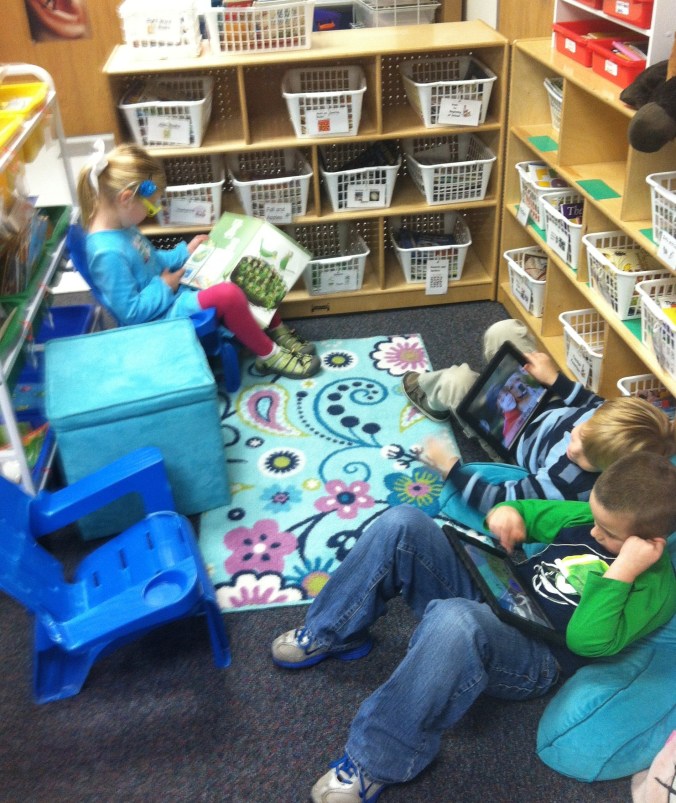
reading choicesHaving choices in reading is no different than that Sunday covered dish luncheon.  My students have the choice of reading regular books, and they can also read from their iPads.  They have many books both hard copy and electronic to choose from.  They can read from a variety of genres and from a variety of topics on a variety of reading levels.  This is a time when more is definitely…well…more.  Already my kindergarten students are referencing author styles, comparing illustrations, and making connections to other texts with their reading partners.  One student recently asked another, “Do you like Eric Carle’s illustrations better than Dr. Seuss?”

Donalyn Miller, author of The Book Whisperer states: “People who lose the ability to make choices become disempowered. This is true for adults, and it is true for young readers. When every book a child reads is chosen for them — by parents or teachers — children lose self-motivation to read and interest in reading. Children should choose their own reading material most of the time, but they need exposure to a book flood to determine what books they like and learn how to choose their own books. ”

Choices encourage engagement, engagement encourages stamina and stamina teaches the curriculum of time.  Children need to learn to read by reading.  By offering them a veritable table of “covered dish” choices, they don’t have to decide between the sweet potatoes and the mashed potatoes…they can have both.  And isn’t that the best of both worlds?  Pass the gravy y’all…

I’d love for you to leave a comment, subscribe to my blog, and/or share this post with a friend.

Digital Letters to Santa

Maybe Christmas, the Grinch thought, doesn’t come from a store.-Dr Seuss, from How The Grinch Stole Christmas

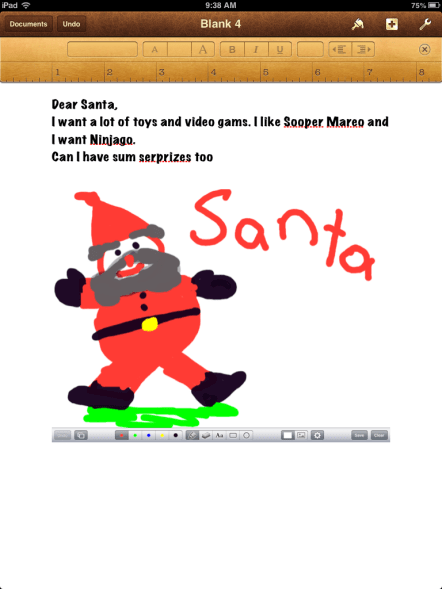
Pages SantaAh…try telling that to a class of 5 year olds.  Ever since the calendar turned to December, my students have been in Christmas mode.  In Grinch-like fashion,  I have been trying to ignore Christmas in the classroom…trying to hold out until next week which is our last week of school before winter break.  My efforts have been met with stubborn resistance.  They want to talk about, read about, sing about and write to Santa.  My steely resolve was usurped…and with apologies to Dr. Seuss, every 5 year old in my class, the tall and the small, was singing and writing without any permission at all!   Mrs. Meeuwse HADN’T stopped Christmas from coming! IT CAME!  Somehow or other, it came just the same!

So, taking advantage of the teachable moment, I turned their desire to write to Santa into a lesson using Pages.  We worked on our writing and then incorporated a drawing from our Whiteboard App.  This activity was easier in small writing groups.  I was able to work with each child on the mechanics of using Pages and how to import their artwork from their photo roll.

Sometimes we have to be willing to give into the frenzy and go with the flow.  Their general excitement was channeled into a meaningful activity that kept them engaged. They were busily writing and talking with their partners about their writing.  I have to admit, even my grinchy self enjoyed the activity. Knowing the fickleness of the 5 year old list for Santa, I imagine we will have several more opportunities to revise, refine, and edit these lists.  This will provide me a few more opportunities to incorporate the writing process.  Having the iPads, we were able to take an age-old activity of writing to Santa and move it into the digital age.

We have 7 more days until winter break.  After all of the excitement, I will definitely be ready for “a long winter’s nap” or at the very least, some Who-pudding and some Who- roast beast.

I’d love for you to leave a comment, subscribe to my blog, and/or share this post with a friend.

Beyond Top Ten Lists

Instead of a national curriculum for education, what is really needed is an individual curriculum for every child.-Charles Handy

It seems everywhere you turn, you find a “must have” app list or a “top ten apps for educators” list.  They list apps that are free or are the favorites of the author.  I used to look quite frequently at these lists when I first started with iPads.  I didn’t want to miss out on that one great app that might instantly transform my classroom.

Now, I rarely look at those lists.  I occasionally write about an app or two in my blog, but it is usually in the context of increasing rigor or advancing personalized learning.  I am often asked what are my “must have apps”.  I don’t mind sharing the ones I use, nor do I mind sharing my favorite ones at the time.  That list changes with what my students need.

Once I asked myself what is my goal of the iPad in the classroom, I found that I didn’t want it to be an “app machine”.  It can certainly be that, but I wanted it to be a tool for learning.  I had to define what that looked like for me first. I was in a meeting recently and someone raised a question and no one really knew the answer.  Within seconds, everyone was pulling out either their iPad or their smart phones to look up the answer.  We can memorize states and capitals, presidents, and other bits of trivia but we also need to teach our students how to solve problems and find information.  We also need to teach them how to find credible sources for that information.  We can’t do that with 2 desktop computers in the classroom, but we can do that with iPads.  By learning to think critically, analyzing information and its sources, we are doing so much more than any app can teach. As we move into personalized learning environments, we need to think beyond just apps.

Having said that, I do use apps daily and I have some apps that are very valuable in reinforcing certain skills.  There are many great apps out there and there are some that are junk.  We have to filter through them and discern the best way to incorporate them into instruction.  As we increase rigor with Common Core State Standards, we can use the iPads for so much more than just apps.  Students can create in writing, arts and music.  They can read and do research. They can explore and extend learning.  If you think your students can’t do it, then think again.  I watch my 5 year olds do it every day.

I encourage all of my iPad teacher friends out there to cut the cord that tethers them to apps.  Ask yourself what is your goal and think about what it looks like for you and for your students.  If you can’t envision it….then trust me, THEY can!

I’d love for you to leave a comment, subscribe to my blog, and/or share this post with a friend.

Increasing Rigor with iPads

It is no longer OK to provide the vast majority of America’s children with a fill-in-the-blank, answer-the-questions, read-the-paragraph curriculum that equips them to take their place on the assembly line.-Lucy Calkins, Pathways to the Common Core

I was recently asked to observe in a 4th grade classroom at my school.  She was implementing some new literacy strategies and wanted some feedback.  It was affirming to see the rigor and engagement of her students. It was also a good reminder of the vertical articulation that needs to occur between grade levels.  As a kindergarten teacher, I seldom get to see my students in action after they leave my classroom.

Our literacy activities involve small group work.  In my class, students read and write for a variety of purposes on their level.  These activities include reading on the iPad as well as word work in various apps and some writing on the iPad.  In the class I observed, students were using iPads to research information for a news article.  They were seeking credible sources and the author of the article.  They were jotting down important facts and comparing information.  Later in the school year, my kindergarten students will be using iPads to research information on various topics.  They will be finding facts to incorporate into their writing. I am building up to that now with iPad activities of increasing complexity with my students.

As we work diligently in our own classroom worlds to prepare our students to move up, it is important to keep a broader view.  We lay a foundation in each grade level that is built upon by the next.  It was good for me to step out of my kindergarten world into the world of “big kids”.  What I do each day is important and relevant.  I think we all need a reminder of that from time to time.

Our students face a different world of challenges than we did.  They will approach problem solving differently.  The implementation of the Common Core State Standards emphasize much higher-level comprehension skills than previous standards.  Readers of today are asked to integrate information from several texts, to explain the relationships between ideas and author’s craft.  Previous literacy efforts defined literacy in terms of basal reading programs with emphasis on seatwork.  The Common Core standards convey that “intellectual growth occurs through time, across years, and across disciplines.” While iPads alone can’t meet these standards, having a powerful, technological tool combined with strong teaching, we can meet and exceed these standards.

I’d love for you to leave a comment, subscribe to my blog, and/or share this post with a friend.